Friday, 4 August 2017

What is IGA ?

"Right this way folks" Stecky the Mascot will
help us  learn all about IGA 2017

So it's almost a month since we got back from our 3rd Eurotrip and I thought it was high time I get my blogging butt into gear. It certainly is a tough life travelling, but one of the many perks of having a European girlfriend. 

This time round we were in Berlin for the start of Summer, though the weather at times didn't want to play nice, but it's hard not to love Berlin. This time around we based our Berlin travels around the IGA Berlin 2017 - "what's a IGA Berlin 2017?" I hear you say, well read on and let's find out.

Now to us Australian's IGA is a supermarket, why would I be excited about going to see groceries? And who would be selling tickets to that? No, silly, the IGA is the Internationale Gartenausstellung, an international garden exhibition held at Garten der Welt in Marzahn, Berlin from the 13th of April to the 15th of October 2017 - a hundred days celebrating "an ocean of colour" which is the motto for the event and as you'll see below, it was brought to life in the form of plants.

"You are here... somewhere"

This wasn't my first trip to Garten der Welt, on our last holiday to Berlin in May last year we stopped in to have a look around. I was very impressed as it is a very well looked after and designed park, displaying garden styles from around the world, collections include Asian, Mediterranean and English gardens. Garten der Welt is within the Erholungspark which totals 250 acres.

In 1987 the park was chosen to hold the horticultural expo know as Gartenschau that commemorated Berlin's 750th birthday. Flash forward 30 years and the site is now in full swing showcasing the IGA 2017.

The original site for the IGA was the former Berlin airport Tempelhof, but in September 2012 the venue was moved to the Garten der Welt. This move saw an additional 15 hectares purchased for the development & construction of future garden displays, which began in 2014. Over 500 designers and contractors were involved in the project that had a budget of approximately 130 million euros.

Our trip to IGA took place on June 24th, an overcast day but very suitable for us all to enjoy what lie ahead. A park & ride system took us from the car park to the venue and within no time we were inside - the first question, where to first? The program & map helped give us our bearings, as much had changed since our last visit. I was getting excited to see both old and new gardens.

My senses were going into overdrive, so many sights and smells. From the main entrance my intuition told me to turn to the right, towards the newly created display gardens, it might have been the pull of the Australian Natives but our first stop was "Cultivated by Fire" an Australian landscape garden design by the creative team at T.C.L. from Melbourne.

Blackened poles symbolise fire stick farming

The colour and the shape - mass planted Ptilotus exaltatus 'Joey'

United colours of Australia - Banksia  underplanted with Chrysocephalum & Scaevola

The garden is inspired by how the Australian aborigines and their ancestors used and managed the landscape with fire. You are almost always guaranteed to run into Aussie's overseas! The garden is accented with mass planting's of shrubs and ground covers to show off form and texture. The Eucalyptus (Gums), Acacia's (Wattles) and Xanthorrhoea (Grass Trees) give focal points throughout the design.

Moving right along, the next few gardens had a heavy Asian and Oriental influence, based on famous design principles from architects in those regions. The lineal use of bamboo  gave boundaries and framed the design and directed "traffic" while the use of sculptures gave focus and the use of water created a calming effect, displaying the flow of energy and life.

Beware the Panda's!
Don't go chasing waterfalls 
"Garden of the Mind" took inspiration from the
southern islands of Thailand.


Waterlilies are are great statement for a garden pond

Probably the most memorable garden design, after the Aussie contribution, was the artificial 'Los Angeles Garden' by Germany's Martin Kaltwasser. The 'garden' is a detailed replica of the miniature garden 'island' at Bergamot Station car park in Santa Monica. The fake palms, fenced off asphalt playground almost perfectly mirrors real life.

Fake news? No just fake palms - the 'Los Angeles Gardens'

Martin adequately displays his idea of how the automobile and the roads that they travel upon has almost explicitly displaced nature in this piece and got a few laughs and smiles from those who strolled by to have a look. Who said German's don't have a sense of humor.

After our jaunt through the newly added international gardens we hopped on the purpose built cable cars, that run from one side of the park to the other, it's a great way to travel through the gardens and gives you an amazing view of the layout.
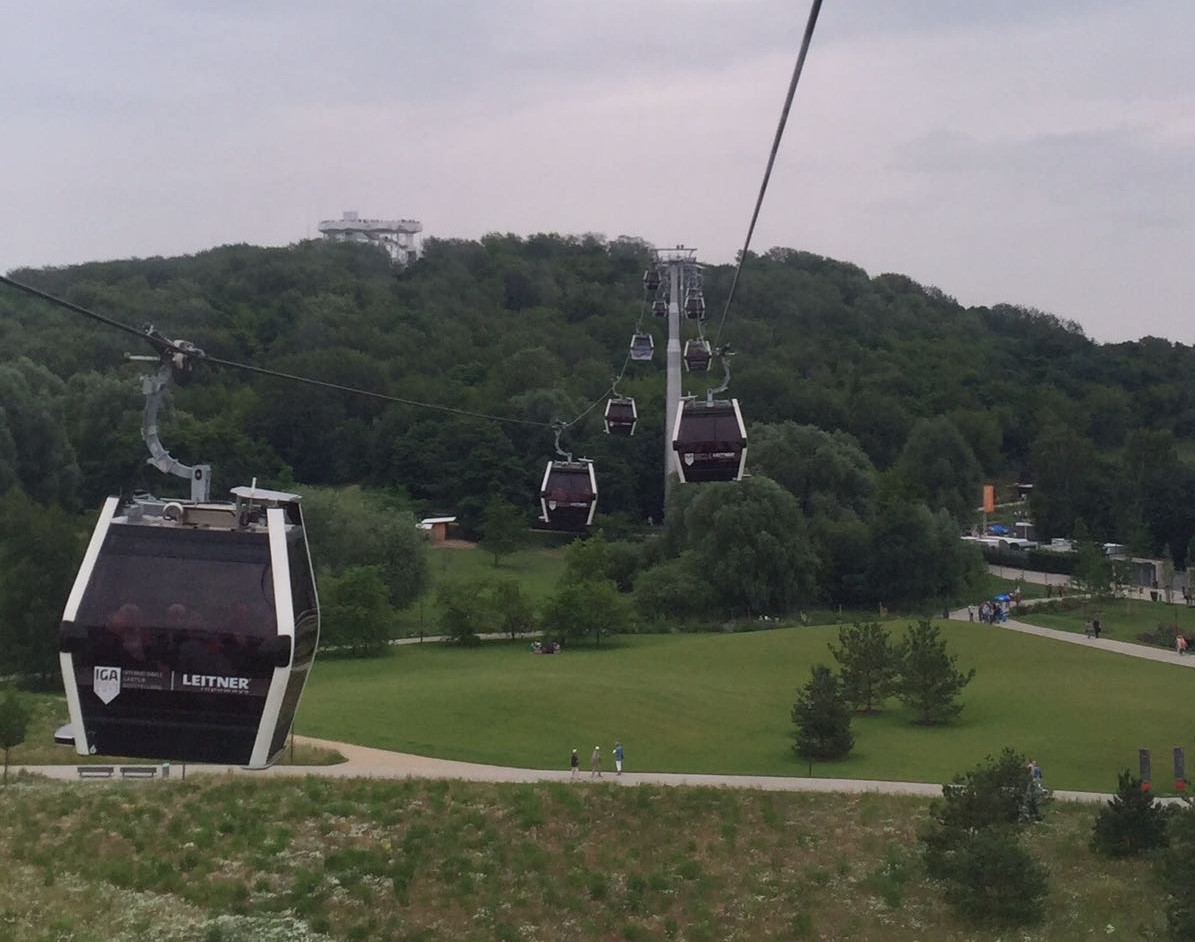
The view from our cable car

Cable Cars in action

There are three cable car stations throughout Garten der Welt, we started on the east (main entrance side) and headed west, towards the mid-way point, the viewing platform know as Wolkenhain.

Der Wolkenhain or Clouds Grove viewing platform
The Wolkenhain view
Now in the western precinct, we made our way back to the entrance. The path took us passed tiered garden beds, show casing many wonderful plants with different foliage form, colour & texture and an array of flower colour,  sticking true to the motto of the IGA "ocean of colours".


On top of these tiered gardens were displays showcasing sustainable gardening, horticultural and landscaping practices. Generally this southern part of the gardens was an educational precinct, giving visitors the chance to learn about environmentally practices and implement ideas at home through practical educational information and demonstrations.
After a well earned lunch break  to rest and recharge the batteries it was onto the Blumenhalle (Flower Hall) to check out the plant displays and new varieties released for the IGA this year. There was an amazing array of plants on show, amazing flower colour, different foliage form with striking architectural shapes and textures arranged with eye catching detail. You really got a sense of the passion of the people that created such displays.

Fagus sylvatica purpurea pendula swamped by Hydrangea's 

Purple and White equals bright!

Many green walls were on display, demonstrating
what you can do to brighten up vertical spaces

The apple 'step over' (horizontal cordon) is an initiative way
to grow fruit in small or linear gardens

There was so much flower, foliage, colour and shape to draw my attention, I couldn't possible take it all in, but I did take many pictures. At this point we had already been there for several hours but I felt like I hadn't seen enough! So before it was time to leave I did a quick walk around to see some of the newer attractions especially constructed for the IGA.

My inner child just had to check out "Konrad reitet in die Suedsee", a play area inspired by the book The 35th of May, or Konrad's Ride to the South Sea by Erich Kaestner. The book shows gardens as wonderful places, full of fun and adventure. The designers and builders who brought this playground to life certainly hit the nail on the head. In fact, Konrad's Ride to the South Sea is the biggest water play park in Berlin, I know my two girls would love it here.

Having a whale of a time!

My final stroll took me past many gardens beds of wonderfully bright flowers, plants of many sizes and shapes back towards the entrance where my German family were waiting (patiently) for me. A staggering 1,500 trees, 6,000 roses, 35,000 perennials and 3000,000 bulbs were newly planted for IGA 2017.


Mass planting equals mass appeal

An estimated 2 million people will visit IGA during the 186 days it's open and the one thing I noticed was the love of gardens and gardening by Germans, they, like many Europeans, really do enjoy their time outdoors and the summer months certainly lifts the mood and inspires you to venture outdoors. It's a good thing after IGA is finished around 85% of the newly created gardens and amenities will remain in place.

I guess summer and sun is a premium for a lot of European countries and they make the best of it while they have it, by tending to and brightening their lives through plants and gardening- even balconies and window sills are adorned with potted plants and planter boxes displaying seasonal colour.  

I really enjoyed the IGA, I wish I had more time to just wander aimlessly. It's crazy how excited I get when I'm in parks and gardens or visiting garden exhibitions or displays, it really makes me feel like a kid - I guess it's in my blood. So if your currently anywhere near Berlin you should definitely check it out, you've only got another 72 days! If you can't make it I hope my blog has given you a little insight into the IGA 2017. You can find out more here if you're still thirsty for more.


Sunday, 11 June 2017

Barangaroo

People have been coming here for a long time, a gathering place for Aboriginals, who would of witnessed some of the first white European settlers arrive. Today many people are coming back to this special place.

In August 2016 there were sculptures to admire

 
Compare the Pear
The Crystal Ball

                                                 
On December 31st 2016 there were New Years Eve celebrations. 

Baby you're a Firework!

During January 2017 there was "The Beach" a sea of 1.1 million plastic balls, a part of the Sydney Festival.

The Beach with balls!


In Mid May it was the Finders Keepers Markets

And tonight it was Vivid

There's always a great reason to visit one of Sydney's newest attractions, Barangaroo Reserve. But you don't need these reasons to go and visit, the transformation to the landscape is reason enough to check out one of Sydney's most important revitalization projects in decades.

Before we look at the now, let's take a look back at the history of the site shall we? The area was named after an Aboriginal tribeswoman, who was a very important female leader to the Cammeraygal people at the time of European settlement.

In the beginning.....


Barangaroo was seen to have a presence and authority not only to her people but to the officers of the first fleet who met her in 1790. Her second husband, Bennelong, was an equally important figure in the history of Sydney, who subsequently had the area where Sydney Opera House is is named after him. Prior to the First Fleet's arrival, the area around Barangaroo was a very important to the Aborigine's for hunting and fishing.

As Sydney developed, the harbour became a very important shipping port and for the remainder of the 19th century it expanded quickly. This time in Sydney's history was also fairly infamous due to the burgeoning unemployment rates, illegal activities in the area and the onset of the bubonic plague that arrived in the very early 20th century. Due to the plague event, the NSW Government intervened and took control and became the authority of the habour port.

In 2003 the state government declared that Sydney Harbour's days as an operational port were over with all services moving to Botany bay. This announcement also signaled the potential future redevelopment of the Miller's Point area.

Fast forward a decade, after a significant planning process the first works on what would become a globally significant development had begun. Barangaroo Reserve was to be a recreation of a landscape that welcomed the first fleet way back in 1788. Turning the flat and lifeless concrete wharves into a raised, rocky outcrop that would encompass 6 hectares of parkland and open space available to the public for the first time in over a century.

Easy, right??? Even in theory it was going to be a massive task, an ambitious project the likes of Sydney had never seen. No landscaping project before had attempted to use 75,000 native plants, but this was no ordinary project. There were 84 Australian native species used through out the reserve, most of those species would have been there prior to European settlement.


The visual impact of the plant palette is emphasized by the use of large Cyathea tree ferns, Fig trees and Livistona palms scattered throughout the landscape. Many other species used were supplied in larger than commercially available sizes to give that established look.

That view though


The reserve is arranged in tiers, with plants of all shapes and sizes filling the the areas in between. Pathways lead up through and around the levels, so visitors get to see the park and surrounding headland from many different vantage points during their amble.

Choose your own adventure


The area at the top is very open and perfect for picnic's as you have a superb, almost 360 degree view from where you stand. It's a little bit of an effort to get up there though, so if you aren't a seasoned hiker (kidding - you don't need to be) there are also elevators for you.

Picnic anyone?


Aside from the wonderful plant display, the other major landscape piece you will notice is the immense use of standstone blocks used around the reserve to create retaining walls and man-made foreshores that link the old sea wall to the creation of a new cove.

Going up?


It is in fact one of a kind - no other project has ever used so much Sydney Sandstone before! In a city with many fine examples of sandstone such as the QVB building, The Australian Museum, Town Hall & Central Station. It's use at Barangaroo ties in well with the rich history using this material in the city landscape.

For sure you have to check out
the foreshore

The new 'man-made' cove


Like the planting undertaken in the reserve, the sandstone creation at Barangaroo was no walk in the park (pardon the pun). Overall, more than 10,00 blocks were used, a whopping 93% of this material was sourced on site during construction of the area know now as the 'cutaway'. The planning, design and engineering perspective is nothing short of amazing, here's some facts to wow you:

* The new headland follows the natural Sydney fault line

* Every grain of sandstone extracted from the site was returned back to the site, either as blocks or crushed up and mixed into the top soil

* It took a year to extract the sandstone used throughout the reserve

* Around 300 different sized blocks were used during the construction of the foreshore

* Each block was assigned a 'bar code' used to ID it through it's journey and final placement

*  A custom designed 12D modelling program designed to map the foreshore and cove and take those 'bar codes' and re-arrange the blocks like a giant 3D puzzle with almost seamless precision

Pretty cool huh? What is truly amazing is the transformation, its easy to forget what the area once looked like.

Before and After


If you have been to Barangaroo before you'll understand my enthusiasm about what is a wonderful public open space, that has been amazingly designed and painstakingly constructed. I have had immense pleasure have had a little part in it and always enjoy stopping in to say hello to my plants.

If you haven't been there, I say check it out! Especially before the new Casino drops in.

 Like I said at the beginning, there's something always happening - for more information check out What's on at Barangaroo and don't forget to say hi to my plants!


Sunday, 30 April 2017

Growing more vertically than usual

A view from the top.

Ten years! That's right, I have been at my current job for 10 years now, it's been a good ride and I have met many cool and passionate plant people, while being involved with some interesting projects. None more so than the One Central Park project, the former site of the CUB Brewery at Chippendale, that has been transformed into Australia's premier sustainable "green" building.

Central Park is one project that is very unique, in so many ways and as someone who worked on this, it has given me immense pleasure to be involved with - even if it was a pretty small role. It is something that I can smile about now but it wasn't always plain sailing - from a horticultural point it was down right stressful and agitating at times. Logistically, it was nightmare to coordinate from growing and sourcing the plants to delivering them, it rarely went smoothly but it was uncharted territory for most parties involved.

I am sure most Sydney-sider's and visitors to the CBD are familiar with the "plant building". It's pretty obvious as you make your way down George Street towards (or from) Central Station. It certainly does stand out amongst the 'regular' buildings that share the area, all you need to do is look up to see the sprawling, cascading plants that adorn the facade.

It was during a short bus ride from Central Station to Glebe Point Rd that made me realise that this building has had a fair amount of impact on the people and visitors of Sydney. I took a seat next to an elderly woman and as we drove past "One Central Park", she noticed me taking notice of the building (for the umpteenth time) "it's wonderful isn't it?" and with that we engaged in a conversation about how this building stands out, that's it different in a good way and that buildings like this one, were something we need more of to break up the concrete jungle.

But we are are at the end of the story, we need to look at what has happened to get us to this point.

Prior to it's current form, the site at Kent Street was a brewery for over 150 years and was hidden by large walls. The area itself has had a colourful past - ravaged by disease during the 1800's and gripped by crime and notoriety throughout the 20th century. The areas became popular due to the burgeoning art and cultural scene but it was the beginning of the end for the brewery industry with Carlton United Brewery closing it's doors for good in 2005.

Former Glory - the CUB site circa 2003.

The Fraser's Property Group bought the land in 2007 with grand plans to re-vitalise the area with mixed urban and commercial development. So when "One Central Park" rose up from the ruins of the former brewery site it promised the Sydney public buildings like no other in Australia. A green building that would be a beacon amongst the drab grey blocks in it's surrounds. It would be a precinct that would give both residents and visitors the ability to connect with the natural world (like it or not) and lessen their impact on the environment.

It was certainly an ambitious project from a landscape perspective, there are not a lot of Aussie examples to draw inspiration or experience from, hence the need to employ a team of world renowned landscape architects. Planning was intense, with the developers undertaking much research, including archaeological digs within the site, to ensure area's heritage and legacy were preserved.

The master conductor of the "plantscape" would be French Botanist Patrick Blanc. He was to design the palette for what would be the world's tallest vertical garden. Flamboyant to say the least, Patrick has been dubbed the inventor of vertical gardens. His work is renowned outside of Australia and he has been involved in some impressive projects already (with many in the works) - you can check out Patrick's work here https://www.verticalgardenpatrickblanc.com/

Exterior Motives? Plants making themselves at home.

There were over 350 different plant species used throughout, a mix of both native and exotic. Plants were generally grouped so they would cut a swathe of colour diagonally and vertically down the buildings exterior. Over 85,000 plants were used, of which approximately 35,000 were used in the vertical wall panels. Next time you pass by, look up and marvel at not only how it was put together but how it is maintained - no easy task!

There is a sense of life after civilisation about this building, if you have ever watched anything post-apocalyptic you'll know what I am talking about, this is how I could imagine plants reacting after humans ceased to exist - to quote Dr Ian Malcolm from Jurassic Park "I'm simply saying, uh.... life finds a way".

Plants aren't the only ones enjoying life on the building. It was this time last year due to the warmer than average autumn weather, where plant growth was still very active, maintenance crews who generally have flowers and foliage to contend with found fauna inhabiting the "gardens". With floral blooms attracting busy bees and wasps, the abundance of water attracting frogs and nearby smoke stacks housing a pair of Peregrine Falcons - this building had truly become an urban jungle.

Not only green on the outside, examples of the developers commitment to sustainability and the environment are contained within the One Central Park site. It has been fitted with state of the art "green" features such as a low carbon, natural gas power plant that produces thermal energy for residents. The development created Central Park Water to self manage & operate all water related infrastructure within the facility - the aim is to have residents use 40-50% less water. The facility also houses a Membrane Recycle Bioreactor, this is the largest water recycling facility in the world.

When you add it all together, you get a pretty impressive piece of urban development, but don't take my word for it, the building has won the following global and national awards:

2015
Best Innovative Green Building - MIPIM Awards

2014
Best Tall Building Worldwide - Council for Tall Buildings and Urban Habitat
Sustainability Award - LEAF Awards
International Green Infrastructure Award - World Green Infrastructure Congress
Development of the Year - Urban Task Force (Australia)

A full list of awards and nominations can be found here.

When the dust settled in late 2013 and was finally complete, my attitude changed a lot! Being invited to the opening and being acknowledged for my role with this project certainly helped me appreciated what we had done and what others had also struggled through to get the job done.

I still look up as I walk or drive by, I am sure you have too, if you haven't had a look you really should - it's hard to miss!


Thursday, 23 March 2017

Shhhhhhh!

"What makes you happy?"

I was posed this question recently by my girlfriend. Being put on the spot, I thought for a moment, then rattled off (in no particular order of preference) the following reply: "You of course, the girls (my daughters), listening to and discovering new music, books, coffee, lying on the beach with the sun on your skin (as long as it's not too hot), plants & gardens too."
The last point made me think of an outing we had as part of my recent birthday celebrations. I love finding (or in this case being brought to) new & different gardens, where you can see collections of various plants on display and where you can have your sense of wonder restored. On this particular day we took a little trip. Not knowing my destination, I looked forward to the adventure that lay ahead.

After a short ferry ride from Circular Quay, we arrived at Milson's Point, we hopped off at the terminal and were greeted by that large (and somewhat creepy) iconic smile at the entry of Luna Park. We followed the Peter Kingston Walkway around past Luna Park. This path, also known as the Comic Walk is lined with miniature statues commemorating the golden age of Australia comics and children's literature, it's worth taking your time to see them all.

At the path's end we came to an underpass, as we walked through to the other side we were met by an impressive set of stairs, to the right of these stairs, an oasis amongst the urban sprawl waited for us.


The ghost who talks - the Phantom greets you on the
other side of the underpass.

Wendy Whiteley had a vision - to turn a run down, weed infested, sloping block into an urban paradise that would be as beautiful as the neighbouring harbour and panoramic views. Wendy is the ex-wife of the late Brett Whiteley, the famous Australian visual artist and painter. Wendy who also has considerable artistic skill, a talent which Brett believed to be superior to his own.

In 1992 after Brett's passing, Wendy channeled her grief into something creative, a 'green' therapy for both her and the derelict piece of land adjacent to her home in Lavender Bay. The 'Secret Garden' wasn't much when Wendy, at great personal expense, took on the arduous task of beautifying a much neglected piece of land belonging to the then New South Wales (NSW) Railway Corporation.

In the beginning - the early years of the Secret Garden.

The site was a mess, littered with old train carriages, broken down machinery and equipment and choked with Lantana, the owners had no intention of doing much about managing their land but luckily didn't mind Wendy's plan to beautify the area, even helping remove some the larger, bulkier pieces of rubbish from the site.

Wendy wasn't alone in her endeavor for long, she has had two long-term helpers to aide in this guerrilla gardening operation, Firstly, Corrado, a Sicilian pizza chef who was walking past the site one day. The other, Ruben, a house painter from Uruguay, both men have been involved for the long haul and are still involved today with a part-time team of gardeners.

Wendy - literally up to her ears in it!

When you visit and I urge that you do, you'll be amazed at the garden for it's current day state but also when you realise what Wendy and her small team faced in the early days. It is one project that any landscape contractor would have had to utilise much more labour and machinery to create the same result, as they say "Rome wasn't built in a day" and Wendy herself says, it couldn't of been created any other way than the way they did it.


Choose your own adventure.

As you make your way through the garden, to the left and right, up and down the carefully crafted winding pathways, framed by natural bush rail balustrades and supported by timber or rock retaining walls you start to appreciate the effort and detail put into this garden. Materials for the project were, bought, salvaged, donated or "borrowed". At every twist and turn there are little trinkets, antiques, sculpt and statues - I think it would take a few visits to find them all.

The garden has it all - even the kitchen sink.

There are many tables and chair settings, benches and picnic tables strewn throughout for those who want to take a breather and soak in the garden or if you are just tired from exploring. On our visit the weather was perfect, as as my company and we had some goodies to savour as we hit the clearing at the bottom, a great spot for a little picnic or a cheeky beverage - we highly recommend it.


"Cheers!"

Take a seat, rest awhile.

Wendy’s efforts were recognised in 2009, when she was awarded the Order of Australia for “Services to the community through the establishment of a public garden at Lavender Bay”.

More recently, in October 2015, the NSW Government (which owns the land) agreed to grant a 30 year, renewable lease on the land to North Sydney Council. This will help ensure the garden remains for the public to enjoy.


Lavender Bay through the trees.

The view from the top.

                                             
The secret garden is truly a work of art, produced by an artist who poured her heart and soul into this project (and still does today). The site is also of spiritual significance to Wendy, the ashes of her ex-husband Brett, her daughter Arkie and her parents have been scattered within the garden.

Wendy’s ‘Secret Garden’ isn’t much of a secret, it is visited by many people throughout the course of the year, but I think the secret part is in the individual’s experience. It’s a place where you can feel a million miles away (even though the Harbour Bridge is almost right beside you) and it feels like you are alone, at peace, once you immerse yourself within it.

Lush garden framed by rock walls.

It's a jungle in there.

The most satisfying about this garden for me is that it feels like gardens of a time not that long ago, when backyards were much bigger, like times spent in my Nan's garden. The narrow, winding pathways will awaken the adventurer within young and old, there is something to find at every turn. Wendy's planting scheme? Well I think Benjamin Franklin said it best "A place for everything, everything in it's place" truly my type of garden!

So go a few hours to spare? Need to recharge the batteries? Fancy a trip on the harbour? Want to go for a little walk? Forget the bright colours of Luna Park, the real attraction is around the corner a bit further and up the stairs! This is a place that is both enriching and enchanting, somewhere to stop and reflect. Oh and don't forget to pack a picnic!

Check out Wendy's Secret Garden for more info.

Wednesday, 22 February 2017

Grafting out a living

Plant propagation has fascinated me for a long time. Being able to create and cultivate new plant life is a very rewarding practice, much like raising a pet or nurturing children it can be hard work, some trial and error but in the end it's all learning and, pardon the pun, growing.

In particular vegetative propagation has been an area of interest to me. Having the ability to take an already established plant to create a new one is a great way to produce plants for next to nothing, a pretty good deal right? Yes, but only if you're prepared to take a chance and give it a go.

There are four main vegetative forms of propagation:

Cuttings

Snip, snip - Rosemary cuttings are pretty straight
forward and a great plant to have for the chef in your house.


This is generally the most widely used method for professional nurseries and backyard gardeners alike. Ensuring you use freshly collected material, take cuttings of growing plants (tips/shoots) and dip into a rooting hormone (powder or gel), then 'dibble' a hole in a pot full of propagation soil mix. Add cutting to hole and secure by pressing gently down on the soil. Sounds too easy? 

Well that was a pretty basic explanation, of course there is more science to it. There are many variables that can effect the success of cuttings and these will depend on the species you wish to propagate and the environment (soil, moisture etc) in which they will be grown.

The most important factor is not to let the soil dry out, keep the soil moist and it is a good idea to cover the cuttings - either with a plastic drink bottle or plastic bag/cling wrap, this helps retain moisture, humidity and lowers transpiration (loss of moisture through the leaves).

Keep the cuttings out of direct light, in a warm sheltered position and mist with a spray bottle a few times a day. When you notice new growth forming and roots at the bottom of the pot, it's time for them to be transplanted.

For beginners, succulents (or succulent type plants) like Senecio, Pig Face, Sedum or Kalanchoe are a very easy way to start to get the 'feel" for it. Others to try are the native ground cover Myoporum parvifolium, Rosemary varities, Westringia, Callistemon, Duranta, Abelia, & Buxus. Though the possibilities are endless and the more you know, the more you can try.


Division

'Divide & Conquer ' Aggies - tough and
reliable, also very easy to divide.

Ever wondered why so many people had "Agapanthus For Sale" sign's in their front yard?  

Probably one of the easiest ways to make more plant from existing stock, given you have big patch (or pots) to dig and split. Division is more often used for clumping plants like grasses, strappy leaf species or those that grow from the spread of underground root structures like tubers or bulbs. 

The best time for division is when plants are hibernating/dormant or during cooler seasons (usually autumn & winter) to alleviate any losses during transplanting. Got some plants to divide? Grab a shovel, dig them up, tease (or cut) them into small portions and replant - wallah! New plants to enjoy. Same goes with potted clumping plants which need some extra leg room. Make some new plants and share with a friend!


Layering

A not so commonly used method these days but still quite a handy and simple way to make new plants. Layering is primarily used for, but not limited to, climbing or sprawling plants and shrubs. There are a couple of ways layering can be done:

Aerial layering is where a portion of the plant develops aerial roots from the stem nodes while still attached to the main plant, this is the point where the new plant will be created. Thinking of it as doing cuttings but kind of in reverse!

In the bag! Aerial layering allows the 'new' plant to
established while still attached to the 'mother' plant.


Once roots start to form, the area can be covered in hessian or plastic wrap with a soil media added for the roots to develop further. Once happy & healthy they can be cut away from the main plant and transplanted into the ground or a pot. This practice was also know as Marcotting. 

Secondly, there is serpentine layering - for all of you out there with a fear of all things slithering, no it doesn't involve snakes! 
Lay it on me - no snakes were harmed in the layering of this plant.

The stem is usually held in place to the soil (or in a separate pot) nearby with wire or pegs while the roots take anchor. Once roots are established and anchored to the ground, the portion below the point of roots can be cut away and the new plant is born!


Grafting

State of the Union - where two become one.

This method of propagation was the main reason I began this blog. Walking and driving around the suburbs of late,  I have noticed a lot of grafted Eucalyptus flowering brightly. It made me think, isn't it a wonderful thing that somebody took the time to bring the Western Australian flowering gum (Corymbia ficifolia) together with a species (such as the more common C. maculata or Spotted Gum) that has a wider geographical range (soil, climate etc), so we can enjoy the floral display they put on. This is also a great species for the home gardener as it's a small tree and because it flowers so profusely it has a shorter, rounder habit.

Corymbia ficifolia "Wildfire"


Corymbia ficifolia "Summer Beauty"
           

Get to what is grafting I hear you yell, okay calm down you lot! Simply put, it is the tissues of two plants that are joined together, the root stock (bottom) and scion (top), to continue their growth together - kind of a horticultural marriage if you will.

The scion is the part selected for it's desired traits such as fruit or flower production. BUT you cannot just go around grafting plants willy nilly, oh no! You can only graft plants from within the same family of plants.

Grafting is certainly not a new fad, it has been around for 1,000's of years and dates back to 2000 BC where it was first used by the Chinese. Today the principles of grafting remain the same - to produce hardier plants, varieties that have better chance of success with increased growth and yield. 

There are many reasons grafting is advantageous, especially in an agricultural world:
  • Fast tracking fruit production by bypassing the juvenile stage (which occurs typically at 5-9 years);
  • Dwarfing - grafting on to dwarf varieties allows higher planting densities, this is especially important within orchard systems, where high yields (such as stone fruit, citrus, apples etc.) are required;
  • Increasing yields by selecting new and improved varieties then combining them with hardy, traditional species takes care of both the above and below ground vigor;
  • Increasing pest and disease resistance - given the advances in plant breeding nowadays, the better selection of hardier varieties is more accessible. Grafting these onto already established root stock also lowers the need for wholesale replanting where previous varieties have failed;
  • Consistency - grafting allows uniformity. The strongest performers are selected or 'cloned' and the result is identical plants throughout the crop. This alleviates natural variation that can produce weaker plants; and
  • Hardiness - plants once labelled as 'difficult' (sounds a bit like my school reports...) now have had the opportunity to be used in wider applications, the home gardener for example.
In an ornamental sense, grafting has allowed accessibility to a wider range of plants than ever before without the need to turn your garden upside down getting the soil composition right. Those fiddly species can now be used with greater chances of success. It also has allowed new 'forms' of plants to be created - topiary and weeping standards add a focal point to any garden through form, shape and colour.

Prunus 'Snow Fountain' - I wonder how it got that name?

I'll be a bit biased now and go on about the great work grafting has done in the field of Australian native plants. Some of the most beautiful examples of Aussie wildflowers occur in areas with very specific soil and climate types such as Western Australia and South Australia. Many of these plants wouldn't survive long in the home garden outside these regions without a bit of intervention. Many of these "difficult" species tend to have a short shelf life anyway but grafting has also improved their longevity.

Your Highness - a weeping grafted Grevillea Royal Mantle.

One of my all time favourite plants is the Silky Eremophila or Eremophila nivea, it's endemic to Western Australia (and is pretty rare in the wild) so to have any longer term success with this beauty you need to splash out the extra and get a grafted form. In doing so you'll be rewarded with year round colour, from it's woolly silver foliage to its alluring purple flowers.

Silky Smooth - Eremophila nivea in full colour mode.

Grafting can be a little more tricky than the previous propagation methods. It is a lot more involved and does take an ounce of skill. So make sure you start with easy to graft species first. Select the right/best method of grafting for your selected species and invest in the proper equipment to get the job done.

So there you have it, plant propagation - a very interesting subject and a worthy hobby to have a go at if you have the time, space and patience. I think us green thumbs tend to find enough of all those things when it comes to the plants we love. So if you've been thinking about, why not take the plunge, there is heaps of info out there on all the techniques mentioned above. Happy gardening.

Friday, 6 January 2017

A bit of abor

They are the link to our past, present and future. They evoke memories in us via sight, smell & touch and as the biggest plants on the planet, trees provide us with many vital things during our lives such as shelter, materials to build homes and furniture and stabilize the ground we walk upon. Trees also provide many bird, animal and insect species homes and food.

Most importantly trees provide us with the oxygen by collecting and storing carbon dioxide from the atmosphere. They help store and filter other pollutants and the health benefits they provide are more than can be measured. So yeah, they do a fair amount for us - imagine them as our lungs (in reverse), they are the Earth's respiratory system.

"A society grows great when old men plant trees whose shade they know they shall never sit in" - Greek Proverb.

This is one of my favourite plant related quotes and to me it says that planting a tree is an investment. It's a connection to the plant world. It gives us the ability to nurture something, as we watch it grow we hope that it will be valued and enjoyed for generations to come. So when did it become OK to manage our trees like this:

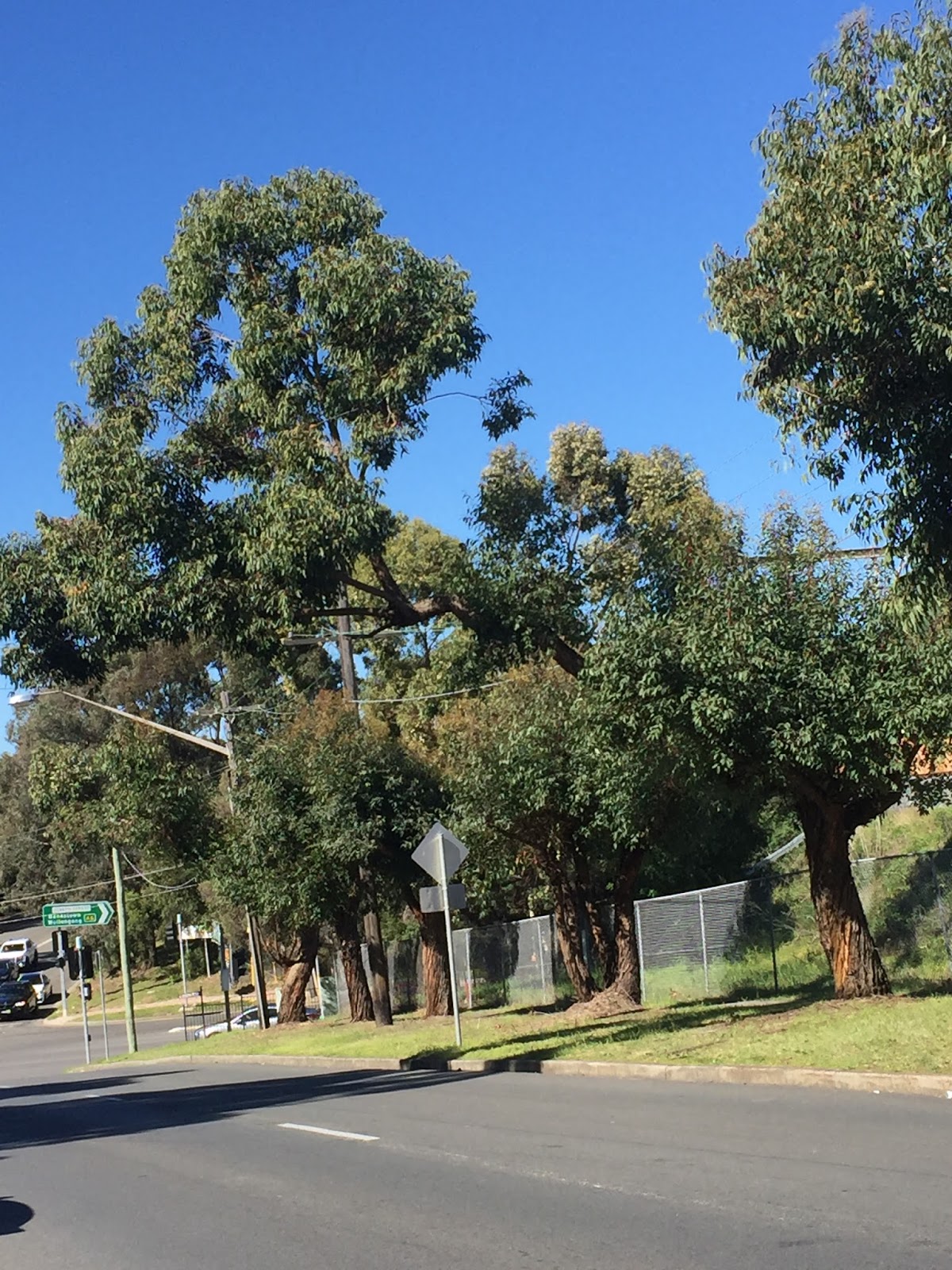
A tree playing limbo with overhead wires at Campsie

What came first, the tree or the power lines? 

As I sit is a newly upgraded park in Marrickville there is a good mix of old established trees and new trees that have been added with the playground redevelopment. I wonder if the older trees in the park look at the new 'new kids on the block' with a small amount of jealousy or perhaps fear? Do they hope that they'll get to see as much as they have?

Parks are areas that you generally can see trees reach their potential as space is not really an issue. Although as you can see below, this conifer didn't quite get the support it needed in the beginning but it does add to it's character.

That windswept look

Being the keen plant nerd that I am, I generally take an interest in the green life in my surroundings and today as I sit in this park, an older suburb of Sydney's inner west I have been inspired to write about the trees in our streets and how they are looked after.

There are a few things in this world that really grind my gears but the way some of our local governments and "arborists" manage our trees, particularly the ones lining our streets, is something that can frustrate me to no end.

I can never seem to comprehend the pointlessness of pruning practices like these shown below:

"Split Personality" - A  Lophostemon confertus in St. Marys


"Hanging Out" - A Eucalyptus sp. at right angles near Chullora

All this "tree management" in most cases is to avoid the nearby power lines, services and other infrastructure. I get it, trees growing into power lines are problematic, trees falling onto houses or roadways is an issue, but who was there first? Is the on going cost to lop branches worth the money and effort? Especially when you see trees which look like they've had the Texas Chainsaw Massacre treatment. These trees, scarred for life, do they have any aesthetic value? Or do they just become and oddity?

Wouldn't it be cheaper just to remove them then to keep them there? Large initial out put for removal Vs. ongoing maintenance? You know the other trees probably make fun of them! To the more natural looking trees, the ones who don't have 'infrastructure issues', they are the laughing stock of the street. I for one really feel for the trees that get hacked to bits periodically - it seems an exercise in futility.

I'm sorry if I keep going back to my experiences in Europe, but gosh darn, it they have a great system for managing their trees. In Berlin and surrounding areas especially, I noticed many street and park trees with number tags attached to the trunks.

A  Betula  in Berlin's Tiergarten proudly showing it's number


This tagging system allows specific maintenance and care for trees. Giving them a number may not seem endearing but it goes along way to showing that they are a public asset and to help record their location, age, species and history. It makes the job of caring for them all the more easy all the while maintaining the cultural and historical significance.

You can argue that given the great percentage of deciduous trees in Europe lends to a better means of maintenance. Having no leaves during the cooler months certainly helps knowing where and what to prune. We don't have such a luxury in Australia with a wider range of evergreen trees.

So what can we do? In older suburbs, not a lot really apart from better education and training to those entrusted with managing our trees, so the best choice can be made and in turn the best care can be applied. Hopefully the end result is we get to enjoy our trees for many generations to come.

It'll be a long time (and pretty costly) before power/telegraph lines are removed and put underground. Until there is wholesale redevelopment in older areas those kind of exercises won't be undertaken. So we need to look at better selection of species when re-planting in these areas, make sure they won't become gigantic trees that will, in the long-term, need costly intervention to stop them becoming a liability

In newer sub divisions and areas being redeveloped, a lot more of our services are being put underground because space is a premium. This means trees can be installed into spaces that allow them to develop more naturally and has alleviated the need for preventative pruning.

Moving forward it's important that we get the tree selection right, putting the round peg in the round hole so to speak. Working together with Landscape Architects, who do the specifying of trees that historically work in said environments (situations/locations etc) and quality nurseries who using best practices, grow their trees to Australian Standards, will go along way in ensuring the quality and health of the trees we plant in the future.

Add the modern systems we have at our disposal (tree pits, soil media, irrigation and drainage systems) in these 'streetscapes', today's trees can have a much better start and brighter future. Like I always, there is nothing better, nothing more important, than proper planning.

Tuesday, 25 October 2016

Mass Appeal

As I was wandering around the city recently, enjoying some nice spring weather (and even nicer company!) I saw a few nice examples of practical and purposeful landscape planting, in new developments and existing, established landscapes.

One thing I've taken notice of a lot lately is the use of mass planting, which made me wonder how I feel about the use singular species planted in big numbers - is it a practical and economic way to fill the green void or just lazy landscape design?

A combination of two grass species -
giving different  heights, colour and texture

Don't get me wrong, mass planting is an extremely useful & practical tool when it comes to alleviating or rehabilitating soil erosion and controlling, dispersing or reducing water run off. Also in nature mono-cultures or low bio-diversity systems also exist and in trying to recreate these vegetation communities, a mass planting outcome is required.

Mass planting of Pachysandra terminalis in
the Tiergarten in Berlin - mimicking it's
natural occurrence.

Away from the recreation of natural systems or planting to protect fragile areas, mass planting in the landscape can create stunning displays of form, texture and seasonal colour. Rows of hedges can be clipped to shape, cutting bold blocks of shape or serpentine lines through the landscape. Grasses and strappy leaf plants can provide multi faceted interest with their long, thin leaves as well as texture & colour contrast through their flowers and inflorescence. Seasonal perennials & annuals will give bursts of brightness throughout the warmer seasons and will attract the eye of passers by.

Pretty Petunia's - they give seasonal colour but need replacing.

However there are pitfalls to planting on mass. By choosing colourful, seasonal annuals you will face the need to constantly replenish them. As the seasons change they'll begin to fade out and begin to look ratty - this is okay of course if your landscape has the budget for maintenance and replanting, if not then there's a good chance it will become an eyesore.

A mass planting of Lomandra longifolia in a park, it mimics
a natural setting but without proper maintenance
looks poor after awhile.

I don't want to sound all doom and gloom but there are a couple of other negatives to mass planting that you will need to know about before undertaking such an exercise.

The first issue is the increased potential for disease and pest problems to occur. In any system with low diversity or a total mono-culture the chances of a disease or a pest causing a problem increases significantly, there just isn't any buffers or filters, does the potato famine of Ireland ring a bell?

But this also gives rise to the "only the strong survive" theory, where the stronger plants that resist will build up tolerances that will be passed on in their genes or will develop mechanisms, such as mass seeding, to counteract the problem of decline.

Gazania tomentosa - tough, great colour
contrast but has the potential to be a problem.

The last point brings me to the next issue - mass planting can encourage the spread of plant species due to increased numbers of seed (or vegetative reproduction) being produced  in a small area. Take the humble Agapanthus, a favourite of the landscape industry and gardeners alike for decades due to it's robust, waterwise nature.

Agapanthus sp. - tough, waterwise, indestructible, weed?

In this writer's opinion, Agapanthus are likely to be, along with the cockroaches, the only thing to survive a nuclear holocaust . There are a number of leafy, bushland suburbs around Sydney that this easy going plant has become a problem, especially in areas of the Blue Mountains with high amounts of run off (to carry seeds into nearby bush) and older storm water systems, here Agapanthus has become a garden escapee.

Of course with monitoring, control as well as the development and advancements in plant breeding we have been available to identify high risk species, manage their movement throughout the landscape and also created sterile or resilient forms that can be enjoyed without the worry of spread or decimation due to pest and disease.

I have always been a fan of the form and function that nature creates, the randomness and beauty from letting nature take it's course. That can't always be achieved in the man made world but we are trying to put our creative spin on things.

So I guess it comes down to choosing wisely, as with any planting situation - do your homework. Look around, what works in your area? What is suitable for your budget and do you have the time to look after it properly? Proper research and planning always goes a long way.