Saturday, 27 January 2018

A leaf out of your book


For our next exciting installment of "Plants that changed the World" I'm going to look at trees. Pretty generic and yes, I have talked about trees a bit in the past, but today I'd like to look at the role they have played in another favourite field of mine, books.

Apart from my love of plants, I have a very strong love of books. Reading has been a hobby of mine since childhood. I have always been surrounded by the written word, be it bookshelves filled with who know's what, to relatives sitting in their arm chairs reading the daily news. What came first, the book or the tree? I think I was climbing trees before I was reading books.

For me it's not just the story inside the covers, but that does help. No, it's the feel of the book in my hands, the smell of the pages and it doesn't have to be a new book, second (or third) hand books are the bestest - they have character and additional stories to tell. It's the main reason I can't get used to my kindle. Sure, the practicality of an e-reader is immense, but give me dog ears and cover crease's any day!

OK, all this talk of books is making me hungry, for a good story that is! So, I thought we might have a look at the history of paper and what actually goes on behind the scenes to produce your favourite books. 

Prior to Paper, civilisation relied on papyrus parchment, made through fairly laborious means. First the stems of Cyperus papyrus reed would be stripped, then softened in water, they were then laid out like a mat, pummeled flat and left to dry in the sun. This practice was developed in Ancient Egypt over 5,000 years ago in 3,000 BC and was widely used throughout the ancient civilsations of Rome & Greece.

Trees have been used in the making of paper for millennia, the earliest record of paper was in Ancient China in 105 AD. Over the next few centuries the art of paper making spread west through Nepal, India and the Middle East by the 8th & 9th centuries. Paper wouldn't arrive in Europe until the 12th century, from there is spread quickly throughout the United Kingdom, then to Canada & Nth America.

It wasn't until the 15th century that paper became thought of as every day, practical items. Thanks to the work of German, Johannes Gutenberg, who introduced the mechanical movable type printing press. Johannes is credited with introducing printing to Europe. With his publication of what today is known as "The Gutenberg Bible", Johannes introduced the world to the possibilities of printed word.  

In the late 18th century, after the flurry of invention that came from the industrial revolution, the mass production of paper began. New production and printing machines revolutionised the means, the time it took and quantity of paper that could be produced. Today, globally, we produce more that 20 million tonnes of paper - that's a lot of trees! Maybe the kindle is looking the better option. 

So which trees are best for paper manufacturing? The answer is predominately fast-growing pine tree species, as they can be grown and managed in sustainable forest plantations. Along with sustainable forests plantations, paper recycling now makes up approximated 33% on all new paper made. 

The list of trees used commonly around the globe for paper production is fairly long. In general, they can be either hardwood (which have shorter fibers, better for printing & writing paper) or soft wood trees (which have longer fibers, giving paper better strength). Some examples of both are:

HARDWOOD:
Acaciaf mearnsii - Black Wattle
Acer rumbrum - Red Maple
Betula papyrifera - Paper Birch & B. pendula - Silver Birch
Eucalyptus camaldulensis - River Red Gum, E. grandis -Flooded Gum & E. saligna - Sydney Blue Gum
Liriodendron tulipifeara - Tulip Tree
Populus tremula - Northern Aspen
Quercus coccinea - Scarlet Oak 
Quercus rubra - Red Oak

SOFTWOOD:
Araucaria araucana - Monkey Puzzle Tree
Picea abies - Norway Spruce & P. glauca - White Spruce 
Pinus radiata - Radiata Pine & P. banksiana - Jack Pine
Pseudotsuga menziesii - Douglas Fir
Tsuga hetrophylla - Western Hemlock

So how many trees does it take to make a book? Or how many books can you make from tree? All good questions, but the answer varies of course, based on the type of tree being used. The good thing is pulp from trees that goes to make paper comes from the bits of the tree not good enough for timber production.

Around 20 trees will produce a ton of paper. The best estimates seem to be that a tree with a trunk diameter of 30cm will produce approximately 260 100 page books, if that helps you put it into perspective.

The other inspiration for this blog happened while on my last trip to Berlin, in June 2017. Back home I had been noticing a few, what I'd call 'little street libraries'. What a fantastic idea! A communal library, without all the shooshing from the cranky librarian. Pre-loved books, in a cute little house, just waiting for a new reader to enjoy the text within, what's not to love?

"Take a book, Leave a book" not a bad motto! 

I think this is a great way to encourage reading, share stories and reuse/recycle books. This local book sharing houses, which are usually painted brightly red and blue, look like smaller versions of the famous London telephone boxes. With little windows allowing would be readers to feed their curiosity just a little more before taking the plunge and opening the door.

Back to Berlin, after doing some google searches to find the locations of local street libraries, I found the perfect one. On my second last day in Berlin I took a stroll down Sredzkistrasse in Prenzlauer Berg, looking for the famous Bücherwald or the Book Forest.

Just past the intersection of Kollwitzstrasse - a leafy, tree lined street, opposite the very pretty Cafe Anna Blume, is a tree not quite like any other I have ever seen. I stopped, looked upon this unusual structure with wide eyed wonder. I am sure many other passersby have had the same reaction to what was the first public bookcase in Berlin.

You can see the Book Forest through the trees.

The Book Forest is the brainchild of Baufachfrau Berlin eV and is a group of five tree trunks, from trees felled in the Grünewald, a 7,400-acre park approximately 10km from the city. The project started in November 2006 and was completed in June 2008. The idea was to aid conscious thought by contributing to "sustainable vocational education and deals with the chain forest-wood-book". The Book Forest received the award for the Official Project of the UN 2008/09 - Education for Sustainable Development.

Like many people before me, I did a little waltz around the collection of logs, taking in the awesomeness. Fascinated, I wasn't sure of the protocol - "Do I just take one?" I am sure the same thought goes through the minds of many who visit. So, I did what any book hound would do, I had a bloody good sticky beak!

The Book Forest also encourages visitors who leave or take a book to be part of that particular books journey by registering it on BookCrossing. Their mission is to connect people through books. This is a fantastic portal for book lovers, kind of like a modern-day message in a bottle. Readers are encouraged to release their books into the wild and see where it goes and is enjoyed, or mark a book if they have found one in the wild, a very cool idea indeed. 

I also had an ulterior motive for seeking out this particular street library, my very talented partner had recently published her first book. 'Baden Verboten" which chronicles what it's like for Germans to travel to Australia. I thought this would be a very special place to release it into the wild. Alas, it's written in German, but you are more than welcome to buy a copy.

Baden Verboten finds a nesting spot in the Book Forest.

And what book did I take with me I hear you ask? A German book about houseplants and their care - another good reason to brush up on my German!

Pflanzen in Unserer Wohnung or Plants in our Apartment

So there you have it, books and trees, just a few of my favourite things. Books give us joy in many wonderful ways, fictional stories to excite or scare and non-fiction books can teach us so many things. It's this understanding we can gain from books that can help us interact with our world.

We know the importance of trees, we need them and they need us just as much, maybe more than they know. Trees are very social beings, with each other and with us, I'll look at this topic in an upcoming blog. Books can encourage us to be social beings by gaining understanding, helping start a conversation or having the knowledge to teach others.

Next time you pick up a book, take a moment to think about what's gone into creating that work, not just the hours the author put into it but the tree that helped created the paper. When you're finished and put that book down, think of the many others that could benefit from the words within, then pay it forward and release it into the 'wild'.


Sunday, 3 December 2017

Rockin' Around the Xmas Tree


The silly season is well and truly upon us. Ever since the Halloween decorations have been taken down Xmas has been shoved in our face with all the might retailers can muster. In fact in 22 days the world will descent into chaos, no wait - that's the boxing day sales!

Apart from Santa, reindeer, and presents, what else symbolises Christmas most? The tree of course! Where else is Santa, travelling all around the globe, pulled along by his band of merry reindeer, going to put all your presents???

The tree is the centre piece to any festive household, that shiny, sparkly beacon that reminds us of the holiday season (and presents, don't forget the presents). There are two main options when it comes to Xmas Trees: real or fake. Both have their advantages and disadvantages of course.

The fake ones usually have a pretty long shelf life with a tiny amount of stress while putting them up and packing them away (sometime in the new year...). These can be bought in a variety of stores, in a variety of sizes and colours at a variety of prices to suit everyone's needs and wants. They are practical and not too much fuss.

The real ones will give you more of a warm and fuzzy feeling. There is also the sense of adventure you'll get as you trek around town looking for the biggest and best, always trying to keep up with the Jones's. The 'Real McCoy' will give you that authentic smell of Christmas in your home.

Oh Christmas Tree - Pinus radiata

Generally to get the 'real deal' you'll be chopping down a Pinus radiata or the Monteray Pine - must be a throw back to the hunter/gatherer mentality of the caveman. In Sydney there is many places you can buy a tree, from going to a 'farm' to select and fell your own or heading to one of many retail  nursery outlets to get a pre-cut one.

Sorry, but I have a slight issue with real Christmas Trees. "Bah Humbug" I hear you yell at your laptop and other devises - but honestly, cutting down a tree, taking it home to decorate, then tossing it to the curb once it's lost it's veneer, sounds a bit wasteful doesn't it?.

Look there are options when you want to dispose of your pre-loved, real Xmas Tree and no it doesn't include taking it to the the tip. Best be trying to recycle that thing, some tree farms can take them back to mulch and reuse on their farms. Certain councils will collect trees after Christmas and those with wood chippers - go nuts and put that tree to good use - ashes to ashes, dust to dust, so to speak.

So what's my suggestion? Have you ever considered a potted specimen? As a southern hemisphere country that has summer Christmas' we do love being outdoors celebrating. Why not have a tree that can join in on all the festivities, by being allowed to be moved around, from inside to out.

There are the traditional potted options of course:

Picea abies - The Norway Spruce

Picea pungens - The Blue Spruce


Picea glauca - The White Spruce

Thuja  occidentalis 'Smaragd'

Juniperus 'Spartan'

Now us plant loving people don't really like common do we? So let's have a look at a few left of field choices you may not have considered. A little disclaimer before we start, I do like my native plants, so you'll probably see a theme developing pretty quickly in my following list:

1. Wollemi Pine (Wollemia nobilis)

Up until 1994 this tree only existed in fossil records, you see this plant was supposed to be extinct, until a chance find by a adventurous National Parks employee brought it right back to life. It was reintroduced to the world and available for gardeners in 2006.

Wollemi Pine - a living fossil

Not only would the Wollemi Pine make a one of a kind Xmas tree, you'll be also doing your part to help conserve this endangered species - Wollemi nobilis has a very restricted range and is limited to fewer than 100 plants in the wild.

If it's relatives are anything to go by (Hoop Pine, Norfolk Island Pine & Kauri Pine) this rare find could get quite big, so keep it in a pot. There is a specialised Wollemi Pine potting mix available from nurseries, use it when potting up or re-potting (every 1-2 years).

It will tolerate short periods indoors with moderate light, outdoors it will prefer a part sun spot. So try one as your next Xmas tree, you can tell your friends and family you have a living fossil that was once food for the dinosaurs.

2. Lilly Pilly (Syzygium/Acmena species)

A fairly popular group of plants in the landscape world due to their quick growing nature and response to pruning, Lilly Pilly's have become much loved as hedges and topiary specimens right around the country.


It's that last point that makes them a good choice for an Xmas Tree. Selecting a medium to tall growing variety like Syzygium 'Resilience', S. 'Bush Xmas', S. 'Northern Select/Select Form', Acmena 'Firescreen', A. 'Hot Flush' or 'A. Sublime' as a potted specimen and pruned regularly will give it a 'cone' shape, keeping it dense and giving you something that you can dress up with ornaments.

Almost all Lilly Pilly's like a good deal of sun, so best to keep these guys outside where they'll get at least a half days worth. Use a good quality potting mix and water well when the temperature  rises. A prune and a feed 4-8 weeks before Christmas will help keep your potted Xmas Lilly Pilly looking in good shape.

Once a year, after the sting goes out of summer its a good time to pot up/freshen up the soil. The good thing with the Lilly Pilly is that it's something that will be quite comfortable if you planted it into the garden, so if you have a space that needs filing or a eyesore that needs screening, don't let it go to waste in a pot.

3. NSW Christmas Bush (Ceratopetalum gummiferum)

How can you go wrong with a plant that has the common name "Christmas Bush"? Each state of Australia has a species that represents them as a Christmas Bush, New South Wales lucked out when we got Ceratopetalum gummiferum.

Lady in Red - Ceratopetalum gummiferum

This tall shrub/small to medium tree grows primarily up and down the east coast of New South Wales, east of the great dividing range. It is well known for the bright red display it puts on prior and up to Xmas. But did you know the red colour that draws attention isn't actually the flower?

The flowers of Ceratopetalum gummiferum are actually cream or white and aren't as striking as what follows. The bright red produced by this plant is actually the colouring of the flower bracts, much like what happens with Bougainvillea and Poinsettia - the true flowers are usually secondary to the colourful outer parts that surround the flowers.

Now the NSW Christmas Bush can be a tricky one when it comes to growing in a neat, dense and uniform specimen. So to undertake this species as a potted Xmas tree will mean a longer term mission of love or simply finding a nice, ready to go specimen at your local nursery.

There is a variety called "Albery's Red" which is a bit smaller growing and has a more vivid, darker red colour - I would suggest his be a better option for your Xmas tree project. Either way, use a good quality native potting mix and as with the Lilly Pilly it's best to have this guy outside in a spot with half a days sun. Prune off the spent flowers to encourage a more bushy habit and more flowers the following season.

4. Norfolk Island Pine (Araucaria hetrophylla):

If you have ever been anywhere remotely coastal I am sure you have seen these statuesque giants along the foreshore adjacent to beaches or in parks nearby. If the sand, the salt water air and sea gulls harassing you for a chip don't give it away, these plant sentinels are a great indication you are near the sea.

The common name is a dead giveaway of where they originate, but they are not a true pine tree although they have some similar characteristics. Araucaria has been kept as periodic house plants in Europe and also have been kept in atrium's of some of the Northern Hemisphere's biggest botanical gardens as they won't tolerate cold winters to well.

So it makes sense in the north of the world to keep them potted and indoors for Xmas. In cooler parts of Australia, younger plants will suffer during cold winters, often having their growing tip damaged and dying out. So potted plants should be given some protection through their 'formative' years.

The toast of the coast - Norfolk Island Pine

The form & branch structure of the Araucaria makes it an ideal tree to decorate, the right angled branches scream "lay some tinsel on me" and "hang those baubles off me". These factors make it a pretty good choice when it comes to potted Xmas Trees BUT a word of warning: they are a 'biggun' so I suggest you only ever have these in a pot, unless of course your background is a football field.

Re-plant or pot up to a bigger pot with a good quality potting mix, suitable for native trees, every 1-2 years. Use an slow release fertilizer recommended for trees in spring and increase watering as it warms up. In our part of the world, they'll be better off more outside than in.

5. Albany Woolly Bush (Adenanthos sericeus):

Hailing from the south of Western Australia, our last contestant enjoys long walks along the beach (but dislikes the water) and also enjoys the Mediterranean (the climate mostly). Once you see and touch this plant it doesn't take long to see why it get's it's common name. The handsome soft, velvety foliage begs to be touched and the small red flowers it bears are attractive to native birds.

It's a fine bush but it's no sheep - it's Silver Streak

Adenanthos are small to medium, fairly compact shrubs ranging to 1-5 metres tall and 1-3 metres wide. The variety known as 'Silver Streak' is particularly fitting for a potted Xmas tree, it's silvery foliage adds that 'just snowed on' look. It's a smaller, more compact variety, that will suit pots better. As a smaller potted Xmas Tree these little native beauties will brighten up the outdoor dining area and make a great table centre piece come Christmas Day.

The dating profile I provided above means the woolly bush is pretty easy going on the watering requirements but does prefer a warm, dry summer (low humidity) so if you do want to try this, a  potted specimen is a good way to start, because you'll able to move it around and find the ideal spot in your patio/garden/backyard.

As summer becomes autumn, a light tip prune will help encourage dense growth and even shape. In pots these guys will do well in a quality native soil mix containing native fertilizer. If you want to add it to your garden, ensure there is adequate drainage and the soil light and open, as they won't tolerate heavy clay soils.

So there you go, a few ideas for a potentially new kind of Xmas Tree this year. You should be able to find most of the plants mentioned in your local retail nursery, especially this time of the year - they'll usually be dressed up and in red pots to make them stand out.

Just remember, a lot of the ones mentioned here and that are available through nurseries naturally grow outdoors, so they should only be used as a short-term prospect indoors. Put them somewhere they'll get a good amount of sunlight and warmth and pop them outside periodically, maybe on the way out the door on your way to work every other morning.

Who says they have to be indoors anyway? You can have second or a third tree outside - 'tis the season after all! Don't be scared to try something new and different, you may just inspire someone else to give it a go next year!


Monday, 13 November 2017

Hop To It!

When I grow up I want to flavour a beer
You would have to agree - plants are pretty amazing things. Their presence enhances our lives in so many ways, without them we'd be far worse off. For millennia plants have and continue to benefit the human world greatly - providing us all with the tools to feed ourselves, build, invent and improve our physical and mental health.

I have been thinking about a series of blogs looking at some of the plants that have made a difference to society. The first is a plant that gives many of us pleasure, helps bring us together by socialising and has become increasingly popular in recent times. 

The fact that I like to enjoy the fruits of this plants labour, coupled with it's importance in my home state of Tasmania has made the humble hops the first subject in what I hope to be an educational look into some of the world's most important plants.

Hops, or Humulus lupulus, have been used as a preservative in beer for centuries. It is the cone shaped flowers of the female hop plant that are used in the brewing process. It is only the female flower cones used in the brewing process.

Hops are also used as the 'herbs and spice' to give beer its aroma and flavour. They can can either add a bitterness to compensate the sweetness from the addition of malt during beer production or they can add a variety of tastes & smells to the beer - including pine, mango, citrus, passionfruit, earth and grass.

The hop plant is a climbing bine, yep you read that correctly, I said bine. Now a bine is a slightly different form of climbing plant, the stems of the vine wrap around it's support in a 'helix' not relying on tendrils to attach to what it's climbing upon. Hops are grown and trained on wire or rope trellis'.

The ties that bine

Humulus grow extremely quick - up to 8 metres a year! This is the main reason they were declared a weed in England during the 15th century when hops were first introduced to the country. Hops are cut almost back to the base of the plant after harvest, as the best flowers are produced on the newest growth, plus it makes harvesting easier the following year.

We are 'hopping' a little ahead here, lets take a look back at the origins of the humble Humulus lupulus.... Hops originate in China but it was in Northern Europe the first documented hop cultivation occurred, it was 736 in the Hallertau region of present day Germany. The first mention of hops being used in brewing was also in Germany in 1036.

Prior to the use of a hops, a mixture know as gruit was used - the mixture contained things such as Ground Ivy (Glechoma), Horehound (Marrubium) and Yarrow (Achillea). But brewers also used things such as aniseed, cinnamon and ginger to giver their batches a certain something.

Germany is still the undisputed king of hop production and if you've ever visited the country you know they sure do love their beer! The Germans even have a beer purity law! That's right, they are strict on what goes into their beer. The Reinheitsgebot was first adopted in Munich in 1487. The best know adoption of the law came in 1516 in Bavaria - this law only allowed the use of Water, Barley & Hops to be used in the brewing of beer. It also set out to created uniform prices for the sale of beer.

Hops only grow in certain latitudes globally, the optimal range is between 35 and 55 degrees North. For example, the two largest hop growing regions in the world - Hallertau, Germany & Yakima, USA are located at 48 and 46 degrees North respectively.

Hop Up - hops growing on purpose built trellis

Today there are over 120 varieties of hops grown in over 20 countries. In Australia we grow approximately 12 varieties. The main growing regions in Australia are Victoria and Tasmania but southern areas of Western Australia and Bilpin in New South Wales are also being trialed as potential regions for hop production.

After several failed attempts to import live plants into Australia the first successful plantings of hops were produced from seed in 1803 in New South Wales, but due to poor site selection the crop was deemed to be a failure.

A former convict by the name of James Squires did however successfully produce the first crop of hops in 1806 from carefully selecting seed and taking cuttings from the 'strongest' of the original 1803 plantings. James was also credited with establishing Australia's first brewey at Kissing Point in Sydney. Today, Mr Squire has been immortalised by the Malt and Shovel brewery that caries his name on their beers.

Now here comes my proud Tasmanian heritage gloat: 60% of the total hops produced in Australia come from the Apple Isle! What else does Tassie do at 60% of national figures??? Tasmania's  geographical position is ideal for hop production.

The cold winters provide enough 'chill' days to break the hop plants winter dormancy. The temperate, cooler spring weather aids in steady and uniform growth. Coupled with it's clean air and water, the Apple Isle suits Humulus lupulus just fine, plus it's Tasmania - god's country.

Tassie's sixty percent of national hop production equates to approximately 1.8 million kilograms - so chances are even if you're not drinking a Tasmania beer, the flavours and aroma's probably come from Tasmanian hops! 2017 marked the 152nd hop harvest in Tassie.

Then....

... and now - how times have changed!

It was way back in 1804 when the first hop plants were planted in Tasmania in the Port of Dalrymple. It was then in 1864 when a man by the name of Ebenezer Shoobridge established a hop plantation at Bushy Park in the Derwent Valley, 55km north of Hobart. Today, the Bushy Park hop plantation is the largest hop plantation in Australia at 230 hectares.

Today's global craft beer market is experiencing a surge in popularity, even if overall beer consumption is falling worldwide. This interest has driven research and development into breeding new varieties to create a wave of flavours and aromas. It is some of Australia's R & D work that is making the world market sit up and take notice.

It seems nowadays when you shop for beer at the local bottle shop you are faced with many choices, it seems each week there is something new to try but I urge you take the plunge and try something different, there is some really good stuff out there away from the 'normal' - so here's some of my favorite local breweries:

Young Henry's Newtown, Sydney NSW
Batch Brewing Company Marrickville, Sydney NSW
Wayward Brewing Co. Camperdown, Sydney NSW
4 Pines Brewing Brookvale, New South Wales
Stone and Wood Byron Bay, New South Wales
Pirate Life Hindmarsh, Adelaide South Australia
Balter Currumbin, Queensland
Moo Brew Bridgewater, Tasmania

So when you are enjoying one of the above beers, or something else that takes your fancy, think of the humble hop plant - an amazing botanical wonder that has given the world much joy over countless centuries. Raise your glass, cheers to hops!

Friday, 20 October 2017

Epiphytes & Parasites Part Deux

Who does't like a good two part-er? You have read the first part right??? If not, you can check it out here.

Caught up now? Ok let's continue...


So we've learnt that the sweet, sweet Pineapples are bromeliads and that bromeliads are epiphytes. Which are plants that reply on other plants for support, to grow on, without any firm grip on the earth and no reliance on soil for nutrient and water. Many types of ferns and orchids are also epiphytes.

A common & popular Epiphyte - the Elkhorn.

In this installment of Ephiphytes & Parasites we look at the latter of the two and delve into the darker side of how plants can manipulate others for their own advantage. Parasitic plants generally have a negative effect on the growth and life cycle of their hosts by using them for more than just physical support, they also tap into their vascular tissue (plant veins) and steal their nutrients and energy.

Parasitic plants need to germinate in close proximity to their hosts, so they can attach themselves to ensure their survival and growth. Some parasitic plants are even clever enough to 'sniff out' their hosts by being able to detect certain chemical 'scents' host plants give off in the surrounding soil.

There are two types of plant parasites: stem - who attach and grow on the above ground parts of the host and the root parasites - that attach themselves to to the root system of their host. In both cases, once the parasite has coupled with the host, they begin to steal their food and water.

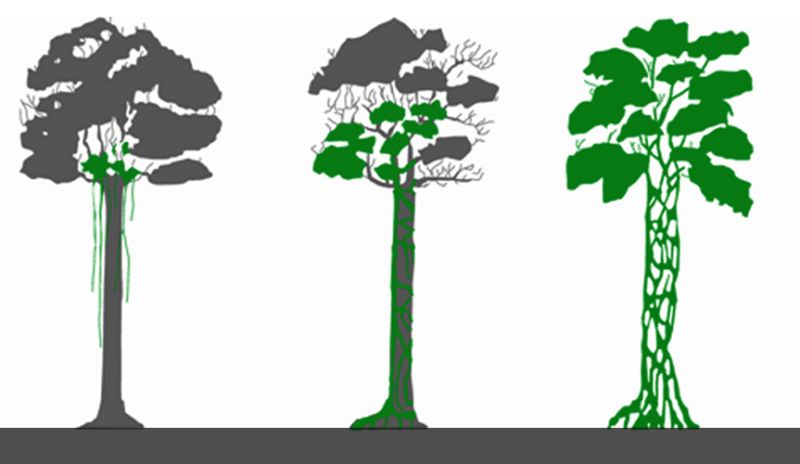
The first plant we'll cast the spotlight on is the group of Ficus (Fig) species known as strangler figs. This common name conjures up images of some kind of nocturnal serial killer but fear not, strangler figs only target other trees and palms.

Now these group of trees are actually an epiphyte, technically classed as a hemiephyte (only spending part of it's life as an epiphyte). It is the potential of these figs to kill others that makes me view them as more parasitic than epiphytic.

The tasty fig fruit is swiftly eaten by birds and dispersed into the canopy of nearby trees. The seed then germinates in the arches of tree branches and begins sending it's aerial roots towards the ground. It's in these early stages that these figs are more like true epiphytes.

The beginning of the end?

This diagram explains the life (and death) cycle of the strangler fig.

In general most Ficus sp. are quick growing. The aerial roots of the strangler fig rapidly descend towards the forest floor, becoming the first anchors and at this point it begins to gather soil water and nutrients, speeding up the growth process. It's not long until the fig will begin to wrap it's multiplying roots around the host plant, holding it tighter than any lovers embrace.

They grow up (and over) so quick!

The fig "take over" looks a bit alien but you have to tip your hat to the awesomeness of mother nature, she sure has equipped some of her 'children' with some pretty handy tools for getting on with life! Due to the fig being more aggressive than the host, the support trees can't compete as strongly for food and water and therefore can't produce new foliage to capture energy from the sun, in most cases they will slowly die out.

Even the end result is pretty impressive:

Inside the hollow, where a host once was.

Up next is a serious weed of agricultural significance. Dodder is a true plant parasite that has a nasty habit of infecting and smothering it's hosts to their untimely deaths. In Australia it causes problems in lucerne pastures and broad leaf and seed crops, contaminating production and reducing yields.

There are over 100 species of Dodder around the world, mainly in temperate and tropical regions. They produce small pink, yellow or cream flowers that produce an abundance of small seeds, that can lay in wait for up to 10 years in the soil. The plants themselves are leafless, having leaf modification resembling minute scales.

Most Dodder species can only produce small amounts of chlorophyll (or none at all), hence their reliance on other plants to get their nutrient requirements.

Who ordered the pasta?

Dodder (Cuscuta sp.) seed germinates close to their hosts by sensing and reacting to chemical cues of potential hosts plants.  They soon intertwine their climbing tendrils with the stems of other plants. These leafless stems then produce Haustoria, a root like structure that pierces and grows into the stems of the host drawing out nutrients.

Got it wrapped around your finger.

Dodder then rapidly grows, spreads over and blankets everything in it's path, not only suppressing growth by stealing nutrients but by smothering & restricting the growth of other plants. In a lot of cases Dodder can be fatal to the host and in crop production losses of up to 10% due to Dodder parasitism or suppression is not uncommon.

Lastly, one of my favourite parasites. Sorry if I have given the previous contestants a bad wrap, I promise that the next one will leave you feeling a bit more warm & fuzzy.

The group of parasitic plants known as Mistletoe's occur around the world. I have been fascinated by theses plants for a long time and more recently my interest was rekindled during a trip to Germany in December 2015.

These species , most likely Viscum album have a more globular habit, forming dense balls and look like decorations in deciduous trees as you can see below:


But I think us Australian's have the prettiest of all Mistletoe's. Down Under we have around 90 species, seventy of which are native. They occur in a wide range of hosts plants, both native and exotic. It can be difficult to spot them in evergreen trees, especially native host trees as they can mimic the leaf size & shape of their hosts. It is much easier to spot them in the canopy of deciduous trees throughout the cooler months without leaves to hide behind.

Mistletoe's are semi-parasitic as they have chlorophyll in their leaves to produce energy for growth but instead use their hosts like a surrogate root system, for support and water.

The amazingly pretty Long Flowered or Apostle Mistletoe 

Many of our native mistletoe's are beneficial to a wide range of wildlife - their foliage, flowers and fruit all are highly nutritious. It's the fruits I'd like to look at now, one of the most interesting things about mistletoe's is the way it has it's seed dispersed.

The seed is encased in a very sweet & sticky fruit which birds love! Birds will devour the fruit like a kid with candy. The fruit is digested fairly quickly through the little stomachs of our winged friends, unfortunately (and somewhat comically for the birds) the seeds remains fairly sticky on the way out!

The male Mistletoe Bird - looks like he wants to dance!

What happens next is a very interesting little dance the birds do to dislodge said seed, check it out here. Once stuck in place, the seed quickly germinates and taps into the lifeblood of the host tree.

It is rare that mistletoe's will cause death in their host's, when it does occur it is generally because the tree was already in poor health. If you must remove the mistletoe, simply remove the branch it's living on. Though I urge you at least to see it's floral display.

So there you have it, a little look at the world of parasitic plants. Some deservedly have a bad reputation, whereas others get an unfair label. But all in all they do deserve a little appreciation, they have evolved to take advantage of others for their own benefit, it's these survival mechanisms that make plants  interesting and worthwhile of further study - who knows what they secrets they still have left for us to discover???