Tuesday, 31 May 2022

OPERATION: Apfelbaum (Apple Tree)


A bit over 2 months ago I was asked by my Father-In-Law if I would like to prune his two apple tree's. Of course I said yes, why not? It's not like I haven't done this kind of thing before*. Given that there had been consecutive days with temperatures in the double digits (just) it was something I better get onto quickly, the new growth bud's were well on their way. In that last week or so I had noticed how many more plants were starting to put a lot of energy into their Spring 2022 campaign. 

* I haven't done this specific kind of thing before

Personally I was quite chuffed, this would be a great little project to do over a day. Early on it was difficult to fill my days with meaningful things, adjusting to my temporary new life in Germany. So I chose a nice warmish day that same week. It worked out well with my son at day care and my partner busy with work, so not to notice me make a fool of myself.

BEFORE: The Red Variety


BEFORE: Klar apfel (White Transparent)

The trees in question are two different varieties of apple, planted around 8 years ago. One is a red, late season unknow variety for eating. The other is an early "Klar Apfel" or White Transparent, being sweet and tart, much better for cooking. These trees were around 4.5-5m tall, so I would have to enlist the help of a ladder - Acrophobia be damned!

I do like a challenge, so after dropping my son off I got straight to work. Preparing myself, I took a few deep breaths, I paced around the trees. Armed with secateurs and loppers and a healthy dose of optimism I was ready, all these years of my partner talking up my horticultural skill to her parents it was my time to shine!

But before we see how I went, lets look at the theory behind why trees need maintenance pruning to manage productivity and longevity. The type of pruning you'll need will be based on the type/species of tree (fruiting or ornamental), it's age and position (park tree or street tree). In my case a fruiting trees can gets pruned fairly regularly. This can be annually or bi-annually, depending on species - as some fruit grows on new growth, some on older. The way it is maintained aims to produce a healthy tree that produces crop year after year (once mature enough).

Trees in parks are usually selected to be robust, long lived and provide shade for park goers, hopefully for many generations to come. Species/varieties are selected that may grow taller and broader, given that they will have more space to grow compared to orchard trees or those that line our streets. 

"Oh give me land, lots of land under 
starry skies above. Don't fence me in"

Park trees will generally have less maintenance after establishment, where the shape of the tree will require less uniformity. During the establishment phase, trees maybe under-pruned to avoid low branches so to enable recreational opportunity and will generally have a good root protection zone created to reduce the amount of pressure and soil compaction from foot traffic.

Street trees are a little different again. They generally need to be varieties that will live better in a modified environment. They will have to live along streets that may not allow adequate space to grow or at least have opportunity to retrofit hardscapes to allow more space. They will tend to be species that have naturally narrow habits or varieties chosen for this specific form (such as fastigiate varieties). 

An avenue of Plane Trees in Berlin

Trees selected for life along our streets will need to have not only an adequate or longer establishment period (a harsher environment) but also an ongoing maintenance period of at least one more growing season (>12 months). This will ensure tree branches can be lifted to an adequate clearance, not only for pedestrians but to create a clear eye line for motorists too.

Urban forestry infrastructure has come along way from digging a tree pit that may be 1m by 30cm and a metre deep for trees. This basically meant the tree was being potted up. We now have some fairly ingenious tree "vault" systems that allow not only adequate root growth but to also house services (electricity, water etc). 

These vaults aim to alleviate crowding without impeding growth. They may be expensive but when you compare it to the life long cost of maintenance and the possibility of failure it seems to be well worth the investment. The type of systems should be considered for every landscape project as it is easier (and cheaper) to have these installed at the start, again it all starts with planning.

Quercus robor Fastigiata - is an
upright, columnar form variety.


The main principles of tree pruning focus on maintenance and intervention. These principles emphasise reduction over removal. Trees obviously shouldn't be allowed to be removed without good reason, e.g. natural decline, pose a threat to property/person or storm damage. There should be adequate management from early on while in a nursery situation up until the end of the maintenance period, careful planning early on will go along way, not only to allow the tree to survive but to flourish. For this reason it is imperative that tree managers involve reputable nurseries that grow to specific tree standards, to help the success of their projects.
So what are the basics of tree maintenance? It's fairly straight forward but putting the time in early is the key. Firstly you want to undertake an overall assessment of the tree. Its physical appearance in relation to the environment around it as you may not be able to correct one without managing the other.
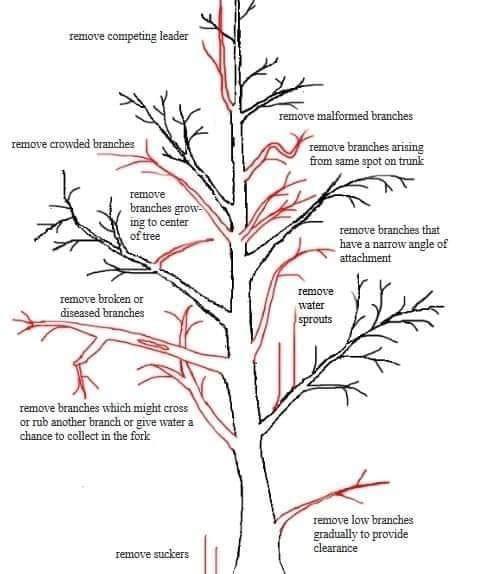
Generally the actions that need to be taken when pruning any tree will be:

* remove or reduce damaged or dead branches/limbs
* reduce or remove competing branching
* intervention to branches that are at angles greater than 45 degrees i.e. growing back towards the trunk
* reduce branch interaction, that is remove any branches that "cross paths"
* open the habitat to allow better air flow and reduce pest and disease occurrence 
* remove suckering stems in the case of grafted varieties

A general guide to pruning

For more specific projects, e.g. involving government agencies, the trees required may be subject to inspection and reporting, looking at some of the following points:

* free from pests and disease
* have adequate and uniform branching/symmetry 
* correct root crown depth (the position of planting in relation to where the trunk meets the roots)
* adequate stem taper (broader at the bottom, getting smaller towards the top)
* apical dominance (a single or dominant growing tip in place)
* self supporting (without the aid of stakes)
* Adequate root development such as root ball occupancy (container specimens) absence of root 
  issues such as "J" roots, girdling or being "pot" bound

The above points are principles good nurseries will incorporate into their best practice for tree production. If you can source a tree that has been given the best start, the chances of establishment and longer term success are increased. Best practice principles have been around for sometime not just in Australia but worldwide. 

In recent years Australia has adopted the Tree Stock Standard for Landscape Use (AS 2303:2018). The objective here is to provide a framework of criteria for not only those who grow trees but the planners, specifiers and end consumers. You can find more info here.

So how did I go you ask? For my first time undertaking pruning of fruit trees I think I did pretty well. Given the slightly late timing of the prune and the two different types of apples, I think the results as of today are as were expected. 


AFTER: The Red Apple Variety 

AFTER: The Klar apfel

The red variety has sprung back into leaf very nicely. Given it is a late season apple I wasn't expecting it to flower strongly, instead it has put it's energy into new growth. I am also not expecting it to produce  much fruit this season and I will recommend it gets thinned out again next winter, possibly taking the top out also to aid in better harvesting.

The Red Variety 12/05/2022

The Klar apfel 12/05/2022

The Klar apfel flowered pretty strongly after pruning, it has some small fruit developing, but given the amount of wood I removed, the yield will be significantly less this season. It has struggled putting on foliage so far, but given it's type I assume this will occur as the fruit matures. This one shouldn't be thinned out again for a few seasons, to allow more fruiting wood, but I will also recommend the top is reduced to help the ease of harvest in future seasons.

The Klar apfel 26.05.2022


The Red Variety 26.05.2022


So there you are, I had a go and I think you can too. I have always thought many areas of plant growing and management can be a bit of an educated trial and error process. As long as you get something out of it, learning, recreation or enjoyment for example, that's the main thing.

Don't be scared to try, if you are worried there is HEAPS of info online, plenty of YouTube tutorial videos and if you are visiting your local nursery ask the horticulturalist on duty, if they are anything like me they'll enjoy a chat about plants. Good luck!


Thursday, 14 April 2022

From little things, Big things grow


At this very moment I am sitting in the sun, in a small village approximately 30km east of Berlin. The sun is a very cherished thing for the Eastern Europeans and you could almost compare the faces of locals to the spectacular blooms of the Sunflower, chasing the sun throughout the day. Even though it is only 8 degrees outside, the sun makes it both bearable and enjoyable outside.

From my spot in the garden I can see bulbiferous spring plants sending up their leaves to capture nourishment for the soon to arrive flowers, the first blooms spring to life on plants brave enough to shed their winter coats. Buds swell on tree branches and the first flowers are appearing on species such as Malus, Prunus and Pyrus.

Luckily I have a fairly large garden at my disposal, this very typical of the surrounding area, not a lot of high density building around here. But as a Sydney-sider, it's easy to struggle with limited space when you have a green thumb. Luckily we have had some forward thinking types who have provided open spaces such as urban and community gardens. The Germans also pioneered this in the late 19th century.

Professor Daniel Gottlob Moritz Schreber

German Physician Professor Schreber worked primarily with young children and adolescents. From 1844 he was the Director of the Leipzig Sanatorium. He became famous as an author, publishing multiple books and papers on raising children and the social consequences of urbanization during the start of the Industrial Revolution. His theories on how babies, toddlers and children should be raised were unorthodox and if proposed today he would suffer much backlash. Although at the time he was considered an authority on the matter.

What the professor did feel strongly about is the health benefits of outdoor physical activity for the nations youth, he saw this as a healthy relief for active children. He also advocated for playgrounds to be built outside of towns due to the limited space around houses. This idea led to what his name is now synonymous with, the Schrebergarten.

A typical Kleingarten setting in Germany
The Schrebergarten movement began posthumously, and the first documented garden was established by Leipzig school principal Ernst Hauschild in 1864 (Schreber died in 1861). These garden allotments began springing up all over German cities during the industrial revolution, providing a source of fresh fruit and vegetables for the less fortunate. It allowed entire families to work a piece of land and provide for themselves.

During the early 20th century, especially during the First and Second World Wars these Kleingarten (small garden allotments) became essential for food production and for survival, as many families struggled with food supply, poverty and malnutrition.

A Schrebergarten in Wenigerode

Today there are almost 1.4 million allotments in Germany, comprising of 833 garden "complexes" and covering around 470 square kilometres. If you spend some time travelling on the outskirts of larger towns and cities, especially on trains, you will pass many of these rambling community orientated gardens. At first you may no think much of them, on the outside, some look a little shabby campsite and you wonder if anyone lives there, garden gnomes perhaps? But once you get amongst them you soon realise that they do show off the individuality of the residents.

The surge in popularity of greenspaces, especially the need to connect to nature, exacerbated by the current pandemic has made urban and community gardening very much in vogue again for those who with limited space. This is also  the case with availability of the Schrebergarten allotments. If you are thinking of getting one, there's an almost 3 year wait list! Plus you'll be in line with approximately 12,000 others who want a little garden of their own.

Looking over the back fence

Of course, being Germany, there are rules! Garden allotment complexes will have a standard rule book, much like by-laws you might find if you are lucky enough to be involved in a strata scheme. Rules can vary from community to community but in general these "laws" will regulate your allotment in regards what you can grow, how far/close your fence can be from the shed, if you can BBQ and  what days and times you can mow your lawn.

But wait there's more Schrebergarten rules: your plot cannot be more than 400 square metres in size. The size of your shed on the allotment cannot be larger than 24 square metres and don't even thinking about residing in your shed. You may or may not be allowed to have chickens or a swing set on the property and your hedge may have to be kept to a certain size. Still want one?

For many decades there has been a stigma around those who keep and manage these small gardens. They have been thought of as being kooks, weirdo's, strict and stringent but it isn't the first time (and certainly not the last) gardening folk have been labelled peculiar. 

The trend is changing due to the younger families getting involved with these garden allotments. Schreber's vision and thoughts on urbanization have certainly rang true, with more and more people starved of the opportunity to have their own green space, hence the demand. The injection of "young blood" into these gardening communities will help drive and popularise it further in the coming decades.

We have all felt the struggle of the past 2 years and we are well aware of the measurable health benefits of connecting with the natural world, us humans have an almost primal urge to do so. The small garden allotment scheme isn't a new idea but it has helped drive other urban gardening policy and biophilic design principles being initiated in cities around the world today. 

Countless community gardens can be found all around the cities and towns you live near. You are sure to find information on line, via council websites or social media. Give it a go, immerse yourself, connect with nature and other like minded people - you'll feel the benefits almost straight away.


Monday, 14 March 2022

I'll Drink to That


Before I turned my hand at horticulture I wanted to be a writer (and for some reason a lawyer). As a child I would make up and write down many elaborate stories utilising the wilds of my imagination. I loved reading and still do to this day. I never quite made it to the best sellers lists but I do have my blog.

I also thought it would be a cool job to review music, movies and books. Didn't quite make it there either, but you know what? I am going to give it a try now. I recently read a very fascinating book called The Drunken Botanist written by Amy Stewart who is an award winning author who has written six books, all based on the wonderful world of plants.

Immediately this book appealed to me because it contains two of my favourite things - plants and alcohol. My thoughtful partner bought if for me as a gift and I was excited to get straight into it, the cover itself was enough for me to see what lies beneath.


Even the books conception is an interesting one: a couple of plant lovers (one of them the author) at a garden writers convention in Portland, Oregon who struck up a conversation about a bottle of gin, but honestly, how many great conversations and ideas have been conceived this way?

It seems that worldwide there's not a tree, shrub, fruit, flower, herb or vegetable that hasn't been harvested for use in an alcoholic beverage. You just have to think about the many wonderous flavours our plants give us for cooking to get an understanding of how far the influence of plants have had on society on a global scale.

The book reads like a cocktail recipe: one part 'how to' plant guide, one part cocktail recipe book and two parts fun facts about how the plants and booze came together. It is an easy to read book, introducing you to many basic concepts of cocktail making, the tools of the trade and it is separated into types of plants and how they influence alcohol production and flavouring.

The Drunken Botanist starts out by explaining the basic terms and definitions about all things cocktails, service sizes, mixers, equipment etc and then begins with the classic cocktails, more specifically the plants that have influenced these classic cocktails.

Of course brewing, fermenting & distilling practices aren't a new thing, these practices have gone on for thousands of years. It seems our forefathers needed a means to unwind and relax after a stressful day even back in the day. 

Throughout the pages of this book you will get a fairly concise history of how various forms of alcohol came to be, from the accidental to the laborious ways our favourite drinks came into being, such as the much loved (and sometimes loathed) Tequila.


Tequila is a very well know and popular spirit, by itself or in the classic Margarita. It has a very long history. It is made from several different types of Agave sp. the species can dictate what it's legally able to be called. Many people think of the desert and cacti when they think of Agave but they are more related to Asparagus.

As the popularity of Tequila has grown, the need for protecting the plants that produce this spirit, especially the species that create the more traditional and legally recognised varieties. By harvesting plants before maturation, in many cases it takes away the ability of the plant to reproduce, therefore diminishing the wild populations.

DID YOU KNOW? Much like Champagne can only be called as such if it's produced in that region, the Mezcal form of Tequila can only be called such if it is produced in the city of Oaxaca (and the neighbouring state of Guerrero), this is law in Mexico.


Grasses (Poaceae) are the fifth largest plant family and the most important economically wordwide. So it makes sense that they have such an influence in alcohol production. They are generally the base for fermentation in such popular drinks as beer, bourbon, gin, whiskey and Vodka. 

Plants such as Barley, Corn, Rice and Wheat are all significant players in the production of the worlds top selling types of booze. Aged Single Malt Whiskey and Gin have had a resurgence in the last few years, becoming a popular drink for the younger generation, no longer drinks for the stuffy, snooty upper class The former being so popular that reserves of aged whiskey are reducing quicker than they can be replenished, therefore pushing up the prices.

You only have to go to the hip city bars to see the confusing selection of alcohol that have been produced thanks to the mighty grass family of plants. 

Rum is another spirit, made from Sugar Cane, that has re-gained some popularity in recent times. For many years thought of as the drink choice for pirates and sea captains, it now has many variants that bind well with assorted mixers and cocktail recipes.

DID YOU KNOW? Rum was certainly the drink of choice for sailors. Prior to Rum, sailors with given beer but beer had a short shelf life and spoilt quickly on long voyages. Sailors were instead given one pint of rum per day, mostly consumed in one sitting! Great for morale, not so great if you wanted your crew to work. 

The Navy decided to dilute the rum ration and give the crew two rations per day. Sailors thought something was up and demanded proof that they were getting what they were entitled to. A method of mixing the rum with gun powder was developed - if the the concoction ignited, there was enough alcohol (approx. 57%) if not, well the navy would have a rebellion on it's hands! This is where we get the term 'proof' from when describing alcohol content.

Step right up! Long lines for the Rum rations

This book is also full of very interesting info regarding how plants influenced the navigation of colonies seeking and founding new lands and influencing trade structure and relations. Amy Stewart shows in many instances how plants are a never ending source of wonder, encouraging you to discover the next amazing piece of trivia throughout the book.

This book reads with seamless ease, with enough tips, recipes and plant facts to keep the pages turning. I assure you it won't take very long to get into this book. Within no time you'll start to appreciate and applaud the plant world for all the wonderful additions they have made to your liquor cabinet or how the local bar tender mixes your next drink. 

So if you're looking for a gift that that I think is a universal fit for most, especially the inspiring drink mixologist in your life, I suggest checking out The Drunken Botanist and maybe grab a copy for yourself, just add your favourite drink and enjoy!


Monday, 8 June 2020

Outside In

It's a Jungle in there

Over the last few years there has been an increase in the popularity of houseplants, not since the swinging 60's & 70's have indoor plants been so popular. A definite surge has occurred with the 20 and 30 somethings taking the leap and owning a plant.

Many factors have led to the increase in popularity. The obvious one is the jump in the social media influence and "influencers" online putting up posts about their new purchase or a carefully placed plant in the background to be noticed by all their adoring followers. 

Social media has also helped growers & plant breeders get their plants out and seen. Nurseries and plant re-sellers also have used online advertising to promote sales and creating events to drive the demand. Just add "collectors item" and watch those plant hunters come out.

The other more obvious reasons for the spike in demand is the size of living in the cities. Apartments are the only thing you seem to see being built, their availability and affordability make them attractive to Gen Y. The lack of a garden means both those with green thumbs and those who are looking to put some green amongst the grey have created a demand for house plants once again. 

All this said, I have absolutely no problems with this, it's great to see the interest in plant life grow (pun intended). Chuck in a global pandemic and people have had the best opportunity to spend more time doing something they love as well as becoming first time plant parents. 

So where do you start? Look there is a million and one platforms online that'll give you an overload of info. So what's the best advise? Check in with your local nursery (no, Bunnings doesn't count) and see what they have to offer. Horticulturalists are great people, passionate and always up for a chat about plants. See what's out there and look for solid, easy to understand advise if you're a beginner.

If you're an old hand at this, look for these so called "collectors items" or the new school plants that are bred to be a bit different (foliage colour/shape, pest resistance) to add tot he collection.

Having lived in apartments the last few years I have tried my hand an indoor plants with some good results. So here are a few old school (and a couple of new kids on the block) plants that have worked well for me and would be a good starting point.

Peace Lily (Spathiphyllum sp.):

These are a staple of many a home or office, not a rare plant by any means but a worthy choice for the beginner. There are a few different species in the market and in more recent times a few new varieties bred for hardiness and flower production. Leaves & flowers can vary in size. 

Flowering can also vary depending on the variety. It prefers a protected, well lit spot and likes humidity. So mist the leaves with a spray bottle in between watering the soil. Foliar feeds (liquid fertilisers) van be given the same way.

The Peace Lily also grew in celebrity status after the 1989 NASA research into the best plants species for purifying the air. It was found that Spathiphylum, in particular the 'Mauna Loa' variety, was the best at breathing in and taking out nasty chemicals from the air.

A peaceful demonstration 

Devil's Ivy/Pothos (Epiremnum aureum):

This is also a certified Nanna's plant and was displayed with pride just like Grandma's best china. It's a climber native to the French Polynesia area where it normally would scramble up a tree trunk for support via it's aerial root system. This is why it's good to give this guy some support in the form of a bark or coir totem pole. Also works well in hanging baskets and will tolerate very low levels of light

Epipremnum is pretty easy to propagate by cuttings, so if you have a friend with one ask nicely for some cuttings. If you can, get a piece that already has some aerial roots forming.

 It also was tested well with air purification in NASA's study. A word of warning, the leaves and stems of Devils's Ivy can be toxic to cats and dogs, so please consider this before purchasing.

The devil is in the detail

Flamingo Flower (Anthurium andraenum):

Another old school favourite that never really went away. This glossy, heart shaped leaf plant from Colombia and Ecuador has a striking red heart spathe (flower petal) with a distinctive elongated white/yellow inflorescence .

The flamingo flower has been a staple of florists and indoor nurseries for decades as it's popularity has never really ever waivered. It prefers a warm but shady position and like the peace lily, enjoys humidity, which helps with it flowering. 

It is a recipient of Britain's Royal Horticultural Society's Award of Garden Merit, it's also listed on NASA's list of best air purifying plants and is also toxic to all mammals (multiple themes developing here), so let common sense prevail before throwing the leaves in your next salad.


Syngonium podophyllum 'White Butterfly':

This dainty, clumping foliage plant with arrow shaped leaves, lending to it's common name the Arrowhead Plant. There are many forms of S. podophyllum, ranging in varying leaf size and colour patterns. It's native to a wide range of Latin America, so it does prefer a warmer spot and works well in varying light indoors.

The leaves of 'White Butterfly" generally have distinct leaf patterns with noticeable "veins" which add to it's character. The amount of light can affect leaf variation, in lighter positions the leaf can hold it's lighter, almost white colour better. In darker spots the leaves are generally greener. It is a semi-trailing plant so it can also work well in taller pots or hanging baskets where it's allowed to cascade. 

Syngonium podophyllum 'White Butterfly'

Mistletoe Cactus (Rhipsalis sp.):

Doesn't look like a cactus but a pretty easy going and cool plant none the less, once you look a bit closer you'll see how it fits in the cactus family. Another South American native, it also occurs in Central America, Florida and the tropical areas of India and Sri Lanka. They are the only group of cactus to be found outside the New World. The increase of trade between countries helped them spread (as did birds who like the berries).

Rhipsalis is a genus of epiphytic cactus, that is they generally don't rely on soil as most plants to get their water and food but via the atmosphere around them. This means it is important to plant them using a media such as orchid bark to stabilise the plant and use a spray bottle to mist the plant.

Given that most species of Rhipsalis grow with a pendulous or sprawling habit, they work well in taller, tapered pots and hanging baskets. It'll enjoy a warmer, well lit spot, such as a window sill or outside on a balcony.

Rhipsalis
Rhipsalis sp.

Zanzibar Gem (Zamioculus zalmiofolia):

This tropical plant, native to several areas of Africa, burst onto the plant scene in Australia about two decades ago and was branded as the bullet proof plant that all the "brown" thumbs could keep alive no sweat. It derives its name to the similarity it's foliage structure/shape has to plants in the Cycad and Zamia families.

Dutch production nurseries began to mass produce the Zanzibar Gem in 1996 and it didn't take long to spread across the globe along with it's popularity with plant collectors. It is just as popular today due to it's ease of care, it structural habit and glossy, succulent stems and leaves. Leaves rise up from a strong underground rhizome,

Leaves reach about 50-60cm long and form clumps as the plant develops. Their leaves are made up of 90% water and is a reason why they can survive long periods of dry. Zamioculus will become deciduous when in drought, shedding it's leaves and storing moisture in the underground rhizomes.

Over watering is the most common reason for declining plant quality, so find a bright spot in the home, out of direct light and water sparingly.

A real gem in the home

Some other  old school favourites are listed below.

Top Left: Mixed succulent & cactus planters for those with a sunny, warm spot. Top Right: Mother in Law's Tongue (Sansevieria sp. also now know as Dracaena sp.).
Middle Left: Spider or Ribbon Plant (Chlorophytum comosum). Middle Right: Ferns are great for a darker space with no direct light. Try the Boston or Fishbone Ferns or natives such as Birds Nest or Maiden Hair Fern.
Bottom Left: The tough and structural Dracaena marginata looks great in a pot. Bottom Right: Cast Iron Plant (Aspidistra elatior) as the name suggests is a tough bugger.


Sunny suckers


It's great to see so many people dip their toes into the world of indoor gardening, it's the kind of panic buying that I'd like to see continuing, who needs toilet paper when you have leaves?! 

A few things to remember before buying your first house plant. There isn't really such a thing as an indoor plant, they all happily grow outdoors in different parts of the world, us humans just try to alter their lifestyles to suit ours.

So when researching your next plant purchase for your house, look at where they normally grow in the world, 9/10 times it will be somewhere tropical with high humidity and high rainfall. So with this in mind find spots in the house that mimic this or can be adapted to provide these requirements. A well lit bathroom is ideal for many of the plants listed above.

Don't over water, in most cases plants will be fine if left to dry out slightly between watering. So observe and act when required. Use saucers to limit spills and stains on your flooring. A good idea is to put a layer of pebbles or gravel under the pot (in the saucer) so the roots don't sit in water and it also helps create humidity.

Fertilise sparingly, unless it's a plant that flowers often. Use a specific houseplant fertilise at the rate suggested, these are usually formulated with higher nutrients to promote leafy growth and for plants in low light situations. Fertilisers can also be applied my misting the leaves with a spray bottle at a more diluted rate.

Wash their hands! I mean leaves, if we have learnt anything from COVID-19 it is that hygiene is very important, even for plants. Plants breathe through their leaves and if they get dirty and dusty it can cause poor transpiration rates and lead to poor plant health. Clean them regularly either with a damp cloth or using a horticultural spray, these sprays add shine to your plants leaves and also protection from nasty pests.

Now that you are giving a plant protection from the elements and warm, pests will find that inviting too. Leafy plants make ideal hiding spots for insects such as scale, aphids and mealy bug. So when your cleaning the leaves, dig a bit deeper and keep an eye out for these pests - it doesn't take long for them to build up in numbers. Remove by hand if possible or use a natural or eco-friendly chemical to manage these pesky buggers.

The health benefits of having plants is amazing. Not only does it give one a sense of nurturing by giving you a sense of purpose and responsibility to a life, there are also numerous health benefits to gardening. Aside from the physical benefits that are more tied to outdoor gardening, the mental health and not so seen or felt physical benefits to indoor gardening are just as rewarding and important.

So while things are getting back to normal, many of us are still working from home, if your office at work is green, why not bring some of that "normality" to your home office. If not, what a great time to start improving your plant/life balance. 

The new normal may just mean that you have to become that "crazy plant person"!


Friday, 17 April 2020

Indigenous/Ingenious


Yesteryear 

In the beginning...

You'd barely recognise Eveleigh when you look at the historical photograph's scattered around the former workshops that maintained and then built NSW growing fleet of steam trains in the late 19th century.

Today the site houses some major corporations (Commonwealth Bank, Mirvac and the 7 Network) is also houses the CSIRO Data 61 (Data Science and Engineering Division) as well as many technology based companies. But prior to all this, it was seen as one of the world's best engineering workshops.

Construction on the workshops started in the early 1880's, on a site that was approximately 60 acres bounded by Newtown, Alexandria, Redfern and Chippendale. The main purposes of this site was to service and repair of existing locomotives but also manufacturing of rolling stock, such as carriages and wagons.

In 1908 the site began to produce steam locomotives and by this time more than 3,000 workers were employed by the workshops, it was the main centre for railway services in the state. By the 1930's many services were expanded (or relocated) to Chullora and Clyde depots. Modernisation of the fleets to electric trains meant the site became obsolete and attempts to upgrade were futile. The site's purpose gradually declined and it's operations ceased in 1988.

Train ride in history

Flash forward to 1995. The site, under the the creative guidance of the NSW Government and local Sydney Universities is transformed into the Australian Technology Park, a hub for technology and scientific research and development. The focus being on educational opportunity integrated with both private and public companies to improve and strengthen Australia's global tech presence.

Retaining the past

In 2015 the site was acquired by Mirvac (a multi-billion property investment and development company). Development of the area continues today and the site offers commercial, housing, recreational and hospitality opportunities. The site retains many old buildings as a nod to it's humble but important beginnings and holds heritage status due to importance to Australia's engineering past.

Tree houses are a favourite of kids (both big and small)

History and culture are important to how we move forward but what we learn from the past is just important. With this in mind, the reason for my latest blog comes from my visit to the rooftop garden situated on top of Yerrabingin House, home to Mirvac in South Eveleigh.

In a garden, high above a rooftop.....

Yerrabingin was founded in 2018 by Christopher Hampson and Clarence Stockee, both Aboriginal descendants who are passionate about their people, celebrating and sharing their culture through various educational opportunities. Together, with the garden acting as a conduit, they have developed a space that not only delivers landscape design principles but programs that are accessible to both the public and private sectors.

Both men have an extensive background in Environmental and Cultural Heritage Management as practitioners and educators. Their idea to disrupt the 'norm' when it came to Aboriginal disadvantage and apply the practices of generations of indigenous people in modern landscape design principles and collaborations.

The rooftop garden was the first project launched by Yerrabingin, after more than a year's collaboration with Mirvac and various community stakeholders. The result is a world-first indigenous rooftop farm that is set up to offer more opportunities for their people to use or learn about their specific skills as well as using the space to promote environmentalism, education and entertainment opportunities.

Multi million Dollar Views

The garden, although small in size, is quite inviting with it's crushed granite path. The garden beds are packed with many natives species, some that generally don't get much of a chance in modern design. Like many of Australia's vegetation communities, the rooftop garden is made up predominately low shrubs and ground covers but this is also dictated by the aspect.

Meet the Locals - a mix of Native Shrubs & Groundcovers

In it's short history the garden has grown over 2,000 edible, medicinal or culturally significant plants. The elevation of the site and the garden beds themselves have lent to somewhat of a trial and error planting - somethings worked that weren't expect to and vice versa. The result is productive garden with culturally significant plants that are supplied to local restaurants and cafes and in turn have encouraged the use of "bush foods" both locally and internationally.

The garden space also lends itself to social and team building events as well as food and drink making courses, all designed to explore the use of lesser know ingredients, that have had much history with Indigenous Australians, but are now becoming more significant to modern communities.

Recently Yerrabingin was awarded the Delicious Outstanding Native Producer by Australia's top chefs and the Australian Institute of Horticulture because of their innovative design and contribution to educational opportunities.

Aussie As Ingredients

The popularity of native ingredients has been driven by enterprises such as Yerrabingin and the need for local flavors to set us apart on the world stage. Australia's Indigenous ancestors have know about the benefits of these plants for many generations and it is the need for this information to be passed on that has allowed the broader community to be able to enjoy these ingredients in more recent years.

Once confined to high end restaurants and hard to access food wholesalers, many native ingredients are finding their way into our supermarkets or being added to our favourite dishes and beverages. Many of us know about plants such as the Macadamia Nut or the heavenly Lemon Myrtle but some of the lesser know things you once wouldn't have know about/be able to find are gaining popularity.

Did you know about such ingredients as Wattle seeds? with their somewhere between coffee and chocolate flavour can be easily added to your next baking adventure. How about the crunchy texture and savoury flavour of Salt Bush? it's leaves that can easily be introduced to your next salad. Or even the Mountain Pepper? that can add a native zing to your next pepper squid.

You can find so much info on native bush foods online, from what plants to grow (and where to buy them - local council nurseries are a great place to start), where to buy processed ingredients and delicious recipes (I have found SBS Food a great source of ideas). If you have the time and can grow or source the ingredients, I suggest giving them a go. It will open a world of new flavours and at the very least a great reason to try something new, (native) variety is the spice of life!

Tasmannia lanceolata - Mountain Pepper

Tetragonia tertagonoides - Warrigal Greens

Wattle Seeds - whole and ground

Atriplex nummularia - Old Man Saltbush

Since I began this blog the world has changed a bit to say the least. The globe has been partially shut down for weeks now and we are all adjusting to a new "normal". I think we can take a lot from the ideas organisations like Yerrabingin and people like Clarence and Christian are promoting - that getting back to basics, having more of a community based outlook will help better sustain our future.

There hasn't been a better time to get into the garden, be you an amateur or expert gardener and try something with a bit more local flavour. Utilise plants and ingredients that are more suited to our conditions and looking to our own backyards before venturing too far. We all complain that we are too time poor but things like pandemics can be a blessing in disguise - time to reset and identify things that matter more and that we can work differently to help us move forward.


Saturday, 8 February 2020

Parched


Australia - a big brown land.

Unless you have been living under a rock or from another planet, you know most parts of Australia are experiencing the worst drought conditions in living memory. Many towns are coming to terms with the very stark reality of life without water.

In Sydney, we have just been put on Level 2 Water Restrictions, these are the strictest levels for over a decade - the last time they were in affect was 4 year period between 2003 and 2008. In 2009 Sydney Water imposed "Waterwise Rules" even after restrictions were receded. These rules were brought into manage and promote more efficient watering practice, these rules included:

* All hoses must now have a trigger nozzle.
* Hand held hoses, sprinklers and watering systems may be used only before 10 am and after 4 pm
   on any day – to avoid the heat of the day.
* No hosing of hard surfaces such as paths and driveways. Washing vehicles is allowed.
* Fire hoses may be used for fire fighting activities only.

Most of the water used in the household is consumed internally but it is usually the garden that suffers the most, being that it is outside, it is the easiest to see (and to be caught out breaking the rules).

 More significantly, for the horticulture industry, nursery trade slows down. People aren't prepared to do anything more to their garden if they can't keep it looking tip top. Although this time of the year is not great to be planting, it usually falls within a time when retail sales are most rewarding for nursery owners. 

So what measures can you take to keep your garden looking good while being water wise? It all starts with good preparation, generally the best time to plant is through Spring and Autumn, avoiding the hottest and coldest parts of the year. These periods are less stressful for you and your plants and are also good times to prepare for the coming extremities.

  • The good soil
Healthy soil will go a long way to helping your plants establish and thrive, even when most under stress. Maintaining soil moisture is important but it doesn't always mean irrigating the ground, you want to build and encourage soils to retail moisture, not too much of course as that leads to other issues, but it is very hard to re-hydrate dry soil. 


Beached as bro!

When soils dry out they become hydrophobic, this is the case for many soils containing higher levels of clay. Irrigate all you like, water will follow the path of least resistance and you'll probably just watch it run off. Now the easy "solution" would be to add a wetting agent. These products break the surface tension allowing the water to penetrate to soil surface and head down through the profile. But soils ain't easy and transformation isn't quick. Good preparation is needed to reduce multiple applications of wetting agent products.

Soils are really slow to change (without serious intervention) and what they need the most is time. The first settlers to Australia found out quickly that a lot of our soil types are impoverished and for over 200 years we have been changing them much faster than natural processes would do, the result  has also had a negative effect on the natural environment.

The heart and soil of a good garden

So when you are starting out or trying to improve soil it will take time, you will need to be patient and persistent. The addition of organic material such as compost is a great way to start changing the composition of your soil. Healthy soil will attract many beneficial organisms that will add life back to the soil, rewarding you with healthier, stress resistant plants. Be prepared to persist!

  • How much mulch?
The practise of mulching has been around for many, many years and is a great practice to start if you haven't done so before. The idea is that it helps insulate the soil temperature and plant root systems. It also slows down soil moisture evaporation and in the long term it breaks down and adds organics back into the soil - circle of life! It also helps suppress weeds that will compete with your more desired plants for food and water.

Mulch can be both beneficial and aesthetically pleasing

How quickly this happens is all dependant on what type of mulch you use. The finer the material the quicker it breaks down. Finer materials may also cause problems with air flow at the soil level and even becoming hydrophobic, which is the opposite of what your trying to achieve. Finer materials should be changed regularly or at least turned to ensure they don't cause these types of issues.

How much mulch you should use depends who you ask. Everyone in the industry seems have a different idea and this just creates confusion. The rule of thumb is about 10cm deep, but this will vary depending on the type of product. You can get many colours and grades (thickness of bark) as well as many types but mostly from bark and wood products which are better for more ornamental type garden settings. Otherwise there are products made from and grasses and legumes (such as pea straw or lucerne) and composted materials which are generally better for vegetable and herb gardens.


Many Mulches - but which one?

Mulching by itself isn't the magic bullet, good soil preparation, as discussed above is critical in good soil health, putting mulch on poor soil is almost the same, except you don't have to look directly at the poor soil anymore. Mulching is another longer term process that will add health benefits to your soil, mulching over good soil is just like slipping into a freshly made bed. 

* Which plants?

Planting the right plant for our conditions is also paramount to have long term success in your garden, not only when water is plentiful but for times like these that Australia is currently experience. The aim should be to create a water wise garden for all types seasons and years.

Information about water efficient gardens can be found all over the internet, other good places are to start are local council or government agencies. The basis of a water wise garden is the selection of hardy plants that have minimal water needs once established.

Try a native - local and adaptive

The first plants that come to mind are succulents and natives, Both have the ability to survive with low water use and in the case of natives, evolved to the sometimes harsh local conditions. The selection and breeding of both these types of plants has resulted in some very pretty and ornamental varieties hitting the market, which gives the home gardener a lot more choice.


Sunny Suckers!

Lastly, check out your own neighbourhood when looking for planting ideas. On your next stroll around the block, pay attention to the gardens in your suburb. In newer areas it's hard to compare older plantings with newer to see what works best. We should maybe also look at the old school ornamental plants that our Grandparents tended to, yes the might be outdated but look at all those terrible boy and girls bands of the 90's - somehow they got relevant again.

Got some space and looking for something to give your garden shade and colour? A few tree species worth trying are Crepe Myrtles - Lagerstroemia sp. (specifically the 'Indian Summer' varieties), Brachychiton including B. acerifolius, B. populneus & B. rupestis (and the newer grafted or hybridised varieties), Olives - Olea europea varieties such as 'Swan Hill' or 'Tolley's Upright' and the fan favourite Jacaranda (Jacaranda mimosifolia)


A trio of toughness Olea 'Tolley's Upright' (Above Left),
Lagerstroemia 'Tuscarrora' (Above Right) and
Brachychiton acerifolius (Bottom Right)


Given our current predicament it's a great idea to look around the streets of where you live and see what's doing well BUT more importantly, what's not. It's something the planners of our cities will need to pay close attention to over the coming months as we look to planting (and planning) for the future.

* Water - the giver of life

One of the most precious commodities on earth, important to every single living thing on this earth. Unfortunately we rely on it too much and for most us, we take it for granted. Although it may not feel like changing your habits will do much on the broader scale, think of the drop of water hitting the pool, the ripple effect can cause waves.

So you have got your soil health on the mend, you've chosen the right plants, the mulch is down - what next? In Sydney you can only currently use a watering can before 10am and after 4pm to water your plants or use drip irrigation for 15 minutes during the same periods. The timing makes sense, especially during summer because it it gets too hot, plants shut down to minimise loss of water through their leaves and stems. It's also much easier on us humans to do it at this time too. 


Drips and drops - drip irrigation gets water to where it's needed.

Installing a drip irrigation system may be costly but it helps get water to the right spot more efficiently while reducing wastage. Irrigation systems can range from basic to high tech and will differ depending on the garden situation. Some automatic systems are smart enough to tell if the soil is dry or wet and water accordingly - but you will pay a premium for a set up such as this.


Yes you CAN - it may be a chore but it helps you get in the garden.

Using just a watering can can be laborious but isn't your garden worth it? If you have a small or potted garden - no sweat! But if you have a larger garden it may be an effort to get water to your plants - so for all you starting off, keep that in mind. Either way it is important to plan how and when you water. An idea is to group your garden in sections and rotate the watering chores. Look at what is growing in your garden and note if it needs more or less water and plan your irrigating accordingly.

So what other ways can you conserve and harvest water? As stated above, most of your household's water is used internally so let's start there. Limiting the amount of water you use is the most straight forward & common sense approach. It might not seem a lot at an individual household level but imagine if everyone did their bit!

Drip, Drop - make that leaky tap stop!

If you are a D.I.Y. kind of person, check your taps & shower head for leaks and replace seals - there's plenty of instructional videos on YouTube but if you're unsure maybe call a plumber, they can also recommend water saving options.

Utilising your grey water also is a good way of re-using that which would literally end up going down the drain. Connecting a extension grey water hose to your washing machine and divert it to your lawn or garden is a good way to keep them green.

BUT, grey water can be high in nutrients that may cause problems with sensitive plants. So before you reuse grey water check what's in your laundry detergent, also check with a local nursery to get tips on what species will do better. It may mean using grey water in conjunction with town water so that nasty elements don't built up in your soil causing a toxicity.

Your time starts.... now!

What else can we do? Limiting your showers to 4 minutes or less is a great start. So if you and partner are comfortable enough - shower together! Or if you prefer a little privacy, how about taking a bucket in with you for company? This will catch excess water and you'll be able to transfer to your watering can and in turn use it on your garden.

There are heaps more tips and hints, you can find plenty via your local water authority such as Sydney Water. So there we have it, a few things you can do to help your garden not just thrive but survive prolonged periods of heat and water restrictions. As I type these final words, it is now the 3rd day of very heavy rainfall around Sydney, but let's not fall back into our old ways cause it's wet outside.

Train yourself, as well as your garden, to be resilient, water wise and productive. Don't just be reactive to sudden and unpredictable change. It is very likely that the weather patterns we have seen across Australia recently will continue - it's up to us to make a difference and it all starts at home.